





ICE Knowledge Hub
Access the very latest and best CPD content to help you grow your knowledge and skills.
Sign in now

The UK could take a leaf out of other countries' books to offer safer, more accessible and innovative cycling infrastructure.

The UK government wants 60% of English children to walk or cycle to school by 2035.
That figure, as of 2023, was at 47%.
Ministers also want over half of all short trips (55%) to be active by this time, which currently sit at 48%.
So how if the government going to close these gaps?
It puts forward a £4.5bn investment strategy that would see around 5,000 walking, wheeling and cycling routes built by 2030, alongside 10,000 safer crossings.
The aim is to make these journeys "more achievable and in line with the way people travel every day".
So perhaps there's a thing or two for the UK to learn from countries where active travel, particularly cycling, is part of everyday life.
The Netherlands, home of Van Gogh, Stroopwafels and bicycles.
While bikes weren’t invented in the Netherlands, there are more of them than people.
It’s the second most common form of transport in the country, with people making roughly 27% of all journeys on a bicycle. In the UK, that figure is a measly 2%.
It’s incredibly safe to do so.
It boasts 25 superhighways for cycling that are currently in use or under construction.
Public safety is a priority, so they sit alongside but separate from roads, have their own traffic light systems and are wide enough to allow ample space for everyone.
Cycling routes are a key consideration when designing, building or updating infrastructure.
For example, the Driebergen-Zeist train station has dedicated cycle lanes built below the station.
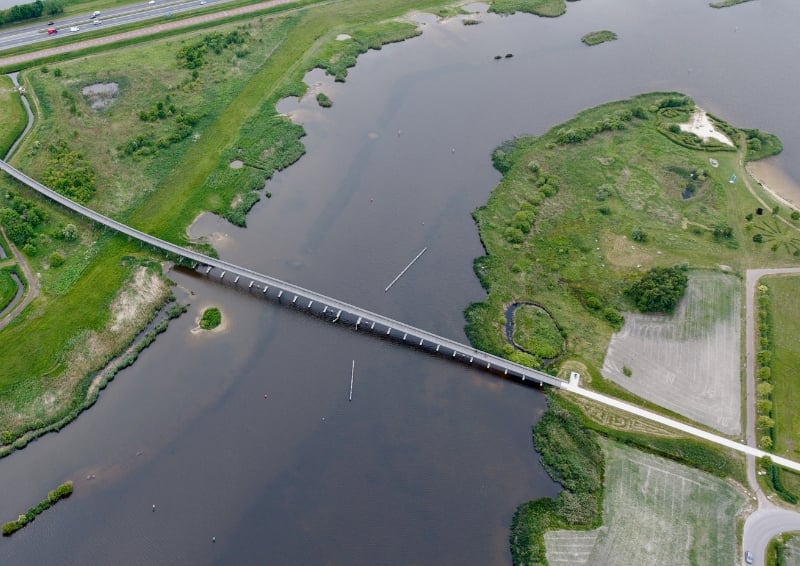
A few other cycling infrastructure highlights include:
Aside from infrastructure, employers may also pay people to cycle to work via a tax-free milage allowance, capping at €0.19 per kilometre travelled.
When public transport use dropped during the Covid-19 pandemic, France was concerned that its sustainability goals would be put at risk by having more cars on the road.
To prevent this, it repurposed road space to create temporary ‘Covid cycle lanes’ across the country.
It also set up a training course on urban cycling known as ‘getting back in the saddle’.
And, it helped individuals service their bikes by providing €50 vouchers. More than 1.7 million bicycles were repaired.
Bike use in France rose immediately. Paris saw a 27% increase compared to the previous year.
This trend continued in the years following the pandemic.
The UK isn’t the most accessible place for cyclists, and often, it can be dangerous.
According to the Department for Transport (DfT), in 2023, 87 pedal cyclists were killed in Great Britain, 3,942 were reported to be seriously injured and 10,970 slightly injured.
The most common cause for fatal or serious collisions was: “driver or rider failed to look properly”.
Given the number of drivers on our roads, people may sometimes forget that they’re behind the wheel of a potentially lethal machine.
“[Driving] must be seen as a privilege, not a right,” says Dame Sarah Storey OBE, cycling Paralympian.
“The safety of vulnerable road users and those out walking must be prioritised by authorities who are not afraid to tackle the greatest threat of harm,” she says.

The highest proportion of fatal casualties occur in two vehicle collisions that involve a heavy-goods vehicle (HGV), which are commonplace in construction.
“Some of these vehicles have blind spots so big, that up to 17 cyclists could be nearby, but not visible to the driver,” explains engineering consultant, Kate Cairns.
“Like we would do onsite, we need to identify and apply risk management processes,” she says.
Supporting this is the Construction Logistics and Community Safety (CLOCS) standard, which requires all stakeholders in construction to take responsibility for health and safety beyond site.
Cairns played a role overseeing the evolution and progression of the standard.
She explains: “Implementing CLOCS requires forethought to include planning for resource and vehicle movements for a construction site in order to reduce its impact on the road network and local community.”
Progress has been made.
In London, the Direct Vision Standard, which rates how well lorry drivers can see the road around them, led to the city banning the most dangerous lorries from the city.
This led to a 62% reduction in fatal collisions.
More generally, the lack of walking and cycling infrastructure in and outside of major cities is keeping people off cycles.
But the low number of people choosing this mode of transport means less demand for better infrastructure, explains Phil Jones, chair of transport planning practice, PJA.
The view was: “No one cycles around here so why should we spend any money on it?”
The numbers back this up. In 2023, the average person spent just six minutes per week on a bike, and cycling only covered 1% of all distance travelled.
Could it be a case of following the old adage, “if you build it, they will come”?
This new investment seems to suggest that's the plan.
The record £4.5bn investment put forward in the third cycling and walking strategy (CWIS3) supports three objectives:
It also builds on existing programmes, bringing together local cycling and infrastructure plans, which account for 20,000mi of planned routes, and almost 7,000 new or improved miles across the National Cycle Network.
The UK government launched Active Travel England in 2022. Its main objective is to create schemes that will enable more people to walk, wheel and cycle safely.
Over the course of the strategy, it will provide £135m of funding to support schools and community programmes to enable millions of children to walk, wheel and cycle to school. It will also help schools to develop their travel plans and support people to start cycling or riding again.
The UK can definitely learn from its European neighbours.
To really get more hands on handlebars, we need safer, more innovative and accessible infrastructure.


The Infrastructure Client Group's 2026 benchmarking survey shows progress, but greater focus is needed on value, data quality and delivery outcome.

ICE President David Porter explains why being informed about flood risk is so important for the public and civil and infrastructure engineers.

The electrification of the Core Valley Lines impressed the judges at the 2026 British Construction and Infrastructure Awards.