Its mission: “public ownership of energy with purpose”. It aims to speed up the move to clean power to ensure communities “reap the benefits of clean, secure, homegrown energy”.
GBE has now published its first ever strategic plan, but will it deliver?
Background: the energy trilemma
GBE’s five-year plan only starts to make sense in the context of the energy system, global and national.
Every country faces an energy policy ‘trilemma’: needing to balance energy security, sustainability, and price.
Fossil fuels often had the advantage of cheapness. But they’ve proven to be exceptionally unsustainable and frequently insecure.
Countries now put a higher value on lower carbon sources of energy, as well as those that make them less dependent on imports.
This ultimately promises to be cheaper, too – but we’re currently in an uncomfortable phase where prices have risen. This is partly because of heavy investment in new energy systems, globally and in the UK.
We’ve pivoted before: from timber to coal, then from coal to oil and gas. Now we’re pivoting again.
But this time, the growing urgency of climate change means it needs to happen quicker than ever.
The new energy mix
In an ideal world, we’d rely on plentiful sources of wind and solar energy (renewables).
But we also need dispatchable power that’s available whenever we need it, even at night and when it’s less windy.
Therefore, we need a more complex system that gives us that ‘always-on’ baseload – whether from nuclear, batteries, or even ongoing gas use coupled with carbon capture.
This system will ultimately have the advantage of lower costs, but needs huge investment now in new means of generation and transmission.
This new grid also needs to be bigger – moving many gigawatts of offshore wind power inland rather than relying on local power plants.
Who’s who in UK energy policy and implementation?
To enable its new energy system, the UK has a forward-looking (if elaborate) ecosystem of new and existing bodies.
Existing
DESNZ (Department for Energy Security and Net Zero): government department responsible for energy policy, net zero strategy, subsidy design, and energy security
CCC (Climate Change Committee): provides expert advice on carbon budgets and climate risks and monitors the UK’s progress on reducing emissions and adapting to climate change
OfGEM (Office of Gas and Electricity Markets): regulator responsible for network price controls, consumer protection, licensing, and enforcing competition rules
LCCC (Low Carbon Contracts Company): arms-length body under DESNZ that runs and manages Contracts for Difference
The usual array of other key players: generators, transmission and distribution system operators, and so on
New(ish)
NESO (National Energy System Operator): responsible for whole-system modelling, transmission and flexibility planning, real-time grid operation, and market operation
GBE (Great British Energy): responsible for developing and owning renewables and strategic clean energy projects
GBE-N (Great British Energy - Nuclear): sister organisation responsible for developing nuclear projects
About the plan
Overall, GBE’s plan is a great step forward, with ambition, clarity, and dare I say, energy running through the document.
Drawing heavily on NESO’s Future Energy Scenarios, the plan also shows reasonably joined-up policy.
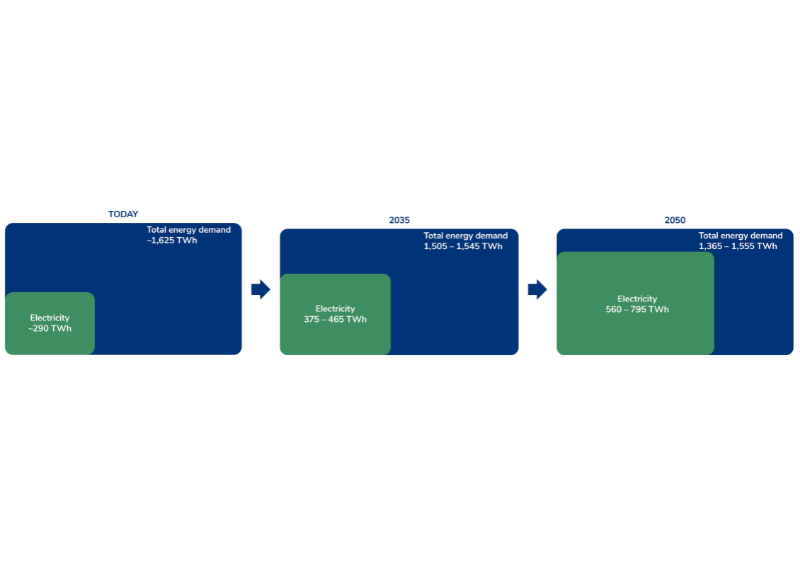
I very much like this graphic in the strategy, which illustrates that while the UK’s overall energy demand will stay relatively static, the proportion delivered by electricity will increase. This means a need for between 2 and 2.7 times more electricity in absolute terms.
This will lead to a cut of 60% of the carbon emissions we need to lose by 2050.
UK electricity and total energy demand over time to the nearest 5 TWh. Image credit: Great British Energy Strategic Plan, December 2025, using forecasts from the National Energy System Operator (NESO) Future Energy Scenarios 2025 Data Workbook. View full size image
Three major steps forward
1. Clear and ambitious targets
GBE commits to delivering 15GW of clean energy and storage by 2030 – enough to power over 9 million homes – and mobilising £15 billion of private finance.
One particularly exciting ambition is the commitment to drive down costs strategically – which happens far too infrequently across UK infrastructure.
2. Commitment as an active investor
Producing a profit-generating portfolio will allow reinvestment for public benefit, rather than paying dividends to shareholders – a key advantage of public ownership.
3. A strong focus on community
An emphasis on local energy systems and supply chains will support UK business and jobs – at least 10,000 jobs by 2030.
Via GBE Local, the company plans to enable far more community ownership of energy assets, which could develop into active market shaping (influencing dynamics such as supply and demand to improve outcomes for consumers).
Four gaps
1. A solution for the transmission conundrum
While the plan emphasises scaling clean energy, this is held back by the slow development of the grid and its huge capacity constraints – overseen by NESO and the transmission system operators.
The plan omits the thorny problem of solving this conundrum.
Connecting more and more renewables to consumers is impossible without parallel upgrades to the transmission networks. The whole system has to work together.
2. Detail on other technologies
The new energy system will be much broader and more interdependent than most imagine.
The transition will also rely on less renewable technologies such as hydrogen (only renewable when enough of the green variety is available) and carbon capture (still dependent on steady oil and gas production, with risk of fugitive emissions such as leaks).
All these parallel sources of energy need to be treated holistically.
3. Clarity on how GBE will work with existing incentives
The plan relies largely on public capital plus private co-investment.
It isn’t clear how GBE will work with policy frameworks, market signals, auctions like Contracts for Difference (CfD), and other incentives and indicators.
4. Detail on nuclear
Beyond “alignment with GBE-N”, there isn’t enough in the plan on how GBE’s renewables and nuclear will integrate at a national grid level.
Both are admirably low-carbon, but “clean” is in the eye of the beholder – depending on your views about nuclear waste.
This is likely because both organisations are still young. But both aspects of the system are important and need urgent attention.
I hope the next version of the strategy will say more on all these gaps. Equally, I expect them to be gaps on paper only – not in implementation.
But overall, the plan is an important step forward in the development of the UK’s energy system. Its confidence and ambition are to be applauded.
The UK industry should use it as a basis to also step up and deliver for the country.
*The ICE welcomes guests to share their views about infrastructure policy issues on the Infrastructure Blog. These views are the views of the individual.
If you're interested in writing for the Infrastructure Blog, please email [email protected]. The ICE reserves the right not to publish articles that have been submitted.
Tim Chapman, partner and director at Boston Consulting Group