





From electrifying rural communities to building symbolic structures, the island or Ireland boasts some incredible infrastructure projects.

The island of Ireland’s civil engineering legacy is rich with projects that combine innovation, impact, and identity.
From electrifying rural communities with the Shannon Hydro Scheme to building symbolic structures like the Peace Bridge, each development tells a story of progress.
Whether it’s iconic landmarks, transformative greenways, or dramatic coastal roads, these projects continue to shape how people live, connect, and move.
Here are some of the most notable examples, in no particular order:
1. Shannon Hydro Scheme

The Shannon Hydro Scheme marked the beginning of the electrification of Ireland. It harnessed the power of the longest river in Ireland, River Shannon, and led to the country's Electricity Supply Board.
The scheme, brainchild of Irish engineer Thomas McLaughlin, brought a reliable supply of electricity to much of Ireland. This sped up the country's commercial and industrial development, and improved the quality of life.
The scheme is also credited with reducing emigration, as improved national infrastructure meant businesses in Ireland could create more jobs.
At the time it was built, in 1929, the scheme was one of the largest civil engineering projects in the world.
In 2002, the American Society of Civil Engineers designated the power station as an Engineering Milestone of the 20th century.
2. Belfast Grand Central Station
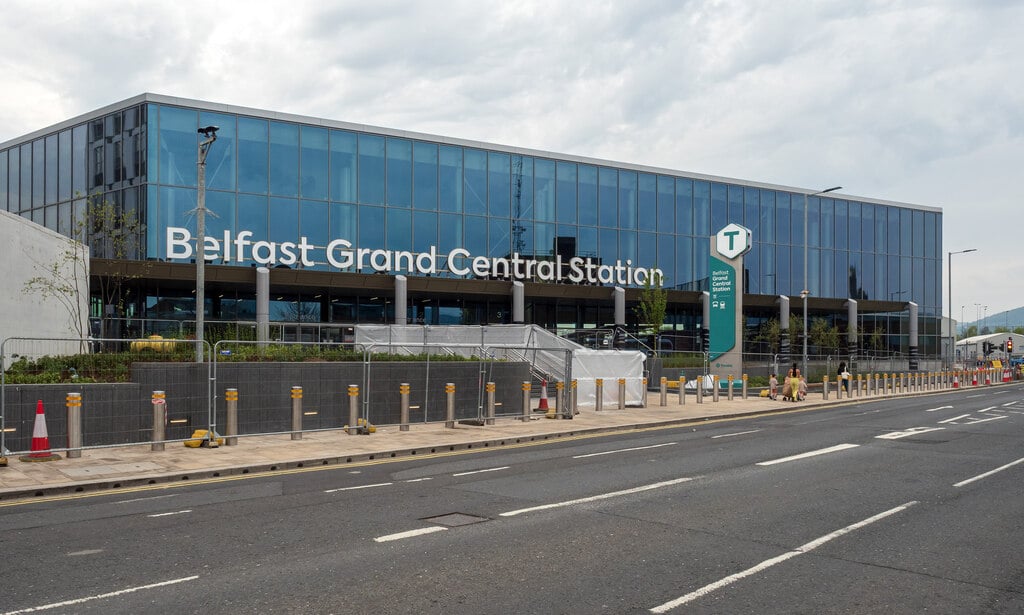
Belfast Grand Central Station began its phased opening on 8 September 2024. It replaced Europa Bus Centre and Great Victoria Street station.
Designed by John McAslan & Partners, it features 26 bus stands and eight rail platforms, making it the largest integrated transport hub on the island of Ireland.
Rail services resumed in October 2024, with the Belfast to Lisburn line.
Part of the wider Weaver’s Cross development, the station is built to handle 20 million passenger journeys annually. It also included modern amenities such as contactless ticketing and rail outlets.
It marks a major step forward in sustainable and connected travel across Northern Ireland.
3. Ha’penny Bridge

Nicknamed the Ha’penny Bridge, the official title of this Dublin landmark is the Liffey Bridge, named after the river the structure crosses.
The Ha’penny Bridge is a single elliptical iron arch rising over three metres above high water at its peak.
The pedestrian bridge was built in 1816. Before that, passenger ferries carried people across the river every day.
When city officials said ferries would require extensive repairs, ferry operator William Walsh elected for a bridge to be built instead.
The only condition was that Walsh would be entitled to a toll of a halfpenny (or ha’penny) from anyone who crossed the bridge for the next 100 years. The city honoured his request, so it wasn’t until 1919 that the turnstiles at either end of the bridge were brought down. By then, the nickname had stuck.
The bridge is made of cast iron and has remained remarkably sound since its construction, only closing for renovation for a few months in 2001.
4. Connswater Community Greenway

In 2013, the EastSide Partnership in Belfast – an organisation made up of local council, housing, and social care groups – won funding to develop a 9km park scheme in the Connswater area.
The scheme was then combined with works to protect against flooding as both projects involved the same river corridors.
As well as protecting 1,700 properties from flooding, the project has created a space that encourages healthier communities, enhanced river water quality and improved diversity of local wildlife.
To celebrate the Belfast-born author’s work, CS Lewis Square was created. It features seven bronze sculptures inspired by his classic children's novel The Lion, the Witch and the Wardrobe.
5. Dublin Airport

Dublin Airport opened on 19 January 1940, with an inaugural Aer Lingus flight to Liverpool, England.
Designed by architect Desmond Fitzgerald, the original curved terminal echoed the lines of an ocean liner and was built to handle 100,000 passengers annually.
Expansion followed quickly, with the North Terminal opening in June 1959 as the new arrivals gate.
In 2010, Terminal 2 and its connected boarding gate pier opened to accommodate over 30 million passengers each year.
More than 400 million people have travelled through Dublin Airport since that first flight.
The airport’s infrastructure continues to evolve, including the addition of the North Runway in 2022, which increased the capacity for long-haul and short-haul flights.
Dublin Airport is also Ireland’s first formally designated carbon neutral airport, following extensive efforts to reduce emissions through building management systems, LED lighting, a pilot solar farm, and more.
6. Living Bridge

Living Bridge is a pedestrian link between the University of Limerick’s grounds on either side of the River Shannon.
The steel footbridge has a light, undulating profile and a sweeping arch that creates organic shapes that complement the unique natural setting.
The bridge was installed with wildlife conservation at heart, so it was constructed off site and then introduced across the river.
Arup oversaw construction, developing a methodology that demonstrated its efforts to minimise environmental impact, since this area supports several species protected under the EU Habitats Directive.
Arup wanted the bridge to celebrate the ‘hidden world’ of the river landscape and encourage pedestrians to appreciate their natural surroundings as they cross.
7. Antrim Coast Road

Until the 1830s, the Glens of Antrim – a region on the north-east coast of Ireland – were largely isolated from the rest of the country by a range of steep hills that rise as high as 360m.
The Commissioners of Public Works in Ireland, a government department that advised ministers, came up with the idea of building the Antrim Coast Road, hoping to generate better access to the area and reduce unemployment by creating jobs.
Civil engineer William Bald was put in charge of building the new road.
He decided to build the road at the foot of cliffs that ran by the sea. This was a revolutionary idea at the time, but it was chosen as it meant the road would be more level.
It is now regarded as one of the great tourist routes in the world.
8. Peace Bridge

This cycle and foot bridge across the River Foyle in west Ulster is an innovative and complex structure, the first of its kind to be built in the UK.
The project brief was to design a structure to link historically divided communities on the east and west banks, both physically and metaphorically.
It was funded by the EU’s Peace III programme, which supports uniting projects like this.
It’s designed as identical halves, each suspended from a single, inclined steel pylon, which overlap at the centre of the river to form a 'structural handshake' - a powerful metaphor for reconciliation, drawing on inspiration from the nearby sculpture ‘Hands Across the Divide’ by Maurice Harron.
‘Hands Across the Divide’ bronze sculpture of two men reaching out to each other symbolises the spirit of reconciliation and hope for the future in Derry pic.twitter.com/GWhA3SsLRo
— ElaineWilson (@egwilson) June 10, 2020
Peace Bridge has now become a focal point for city events as well as a valuable transport link. It even has its very own Royal Mail postage stamp!
9. St Patrick’s Bridge

St Patrick’s Bridge is one of Cork’s most famous bridges.
The 90m long, three-span masonry arch bridge links the main street to St Patrick’s Hill and is a landmark in the city.
It recently underwent a major €1.2 million refurbishment scheme to secure its future. Funded by Transport Infrastructure Ireland, the project restored the bridge’s limestone fabric and iron features to their former glory, from when they were first built in 1861.
When the bridge opened after renovation, a formal opening ceremony took place, with Cork County Council inviting anyone named Paddy or Patricia – in any language – to join the celebration for a special commemorative photograpy. More than 158 people turned up!
#158CorkPaddys pic.twitter.com/JBWgtwLJbW
— The Metropole Hotel Cork (@MetropoleCork) March 16, 2019
10. Ulster University
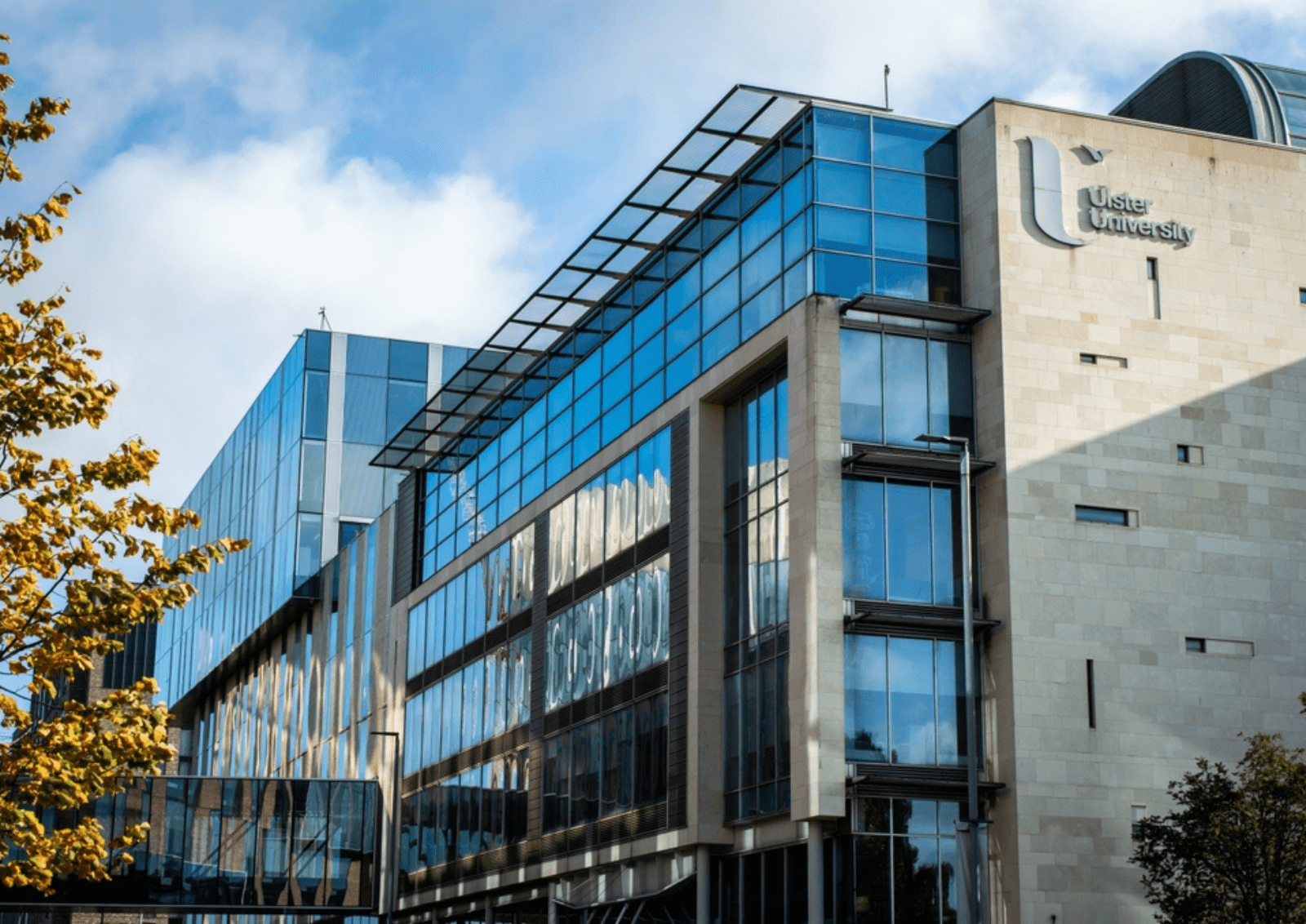
Ulster University’s improved Belfast campus officially opened on 19 September 2022, welcoming over 15,000 students and staff to the city centre.
Inspired by the surrounding Belfast hills, the 75,000m² development is one of the largest higher education new builds in Europe.
The campus brings together creative, scientific, and entrepreneurial disciplines under one roof. It plays a key role in the £1.4bn regeneration of North Belfast.
It also reflects the university’s commitment to sustainability and social impact, with extensive training, apprenticeships, and community engagement built into the project.
11. Samuel Beckett Bridge
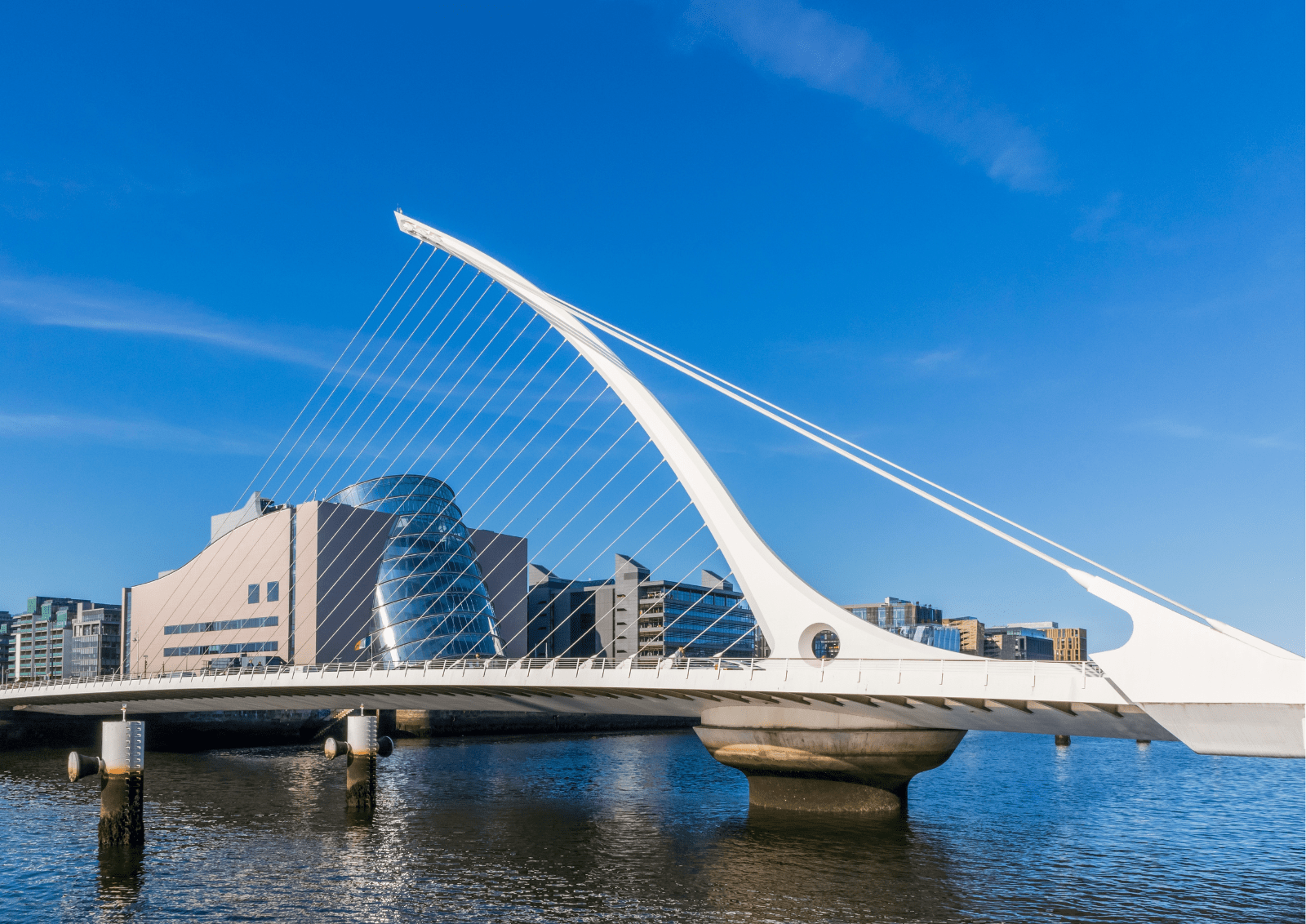
The Samuel Beckett Bridge opened to pedestrians on 10 December 2009, with road traffic following the next day.
The bridge spans the River Liffey to link Sir John Rogerson’s Quay to North Wall Quay in Dublin’s docklands.
Its striking harp-shaped design pays tribute to Ireland’s national symbol and features a cable-stayed structure with 31 cables. Uniquely, the bridge can rotate 90 degrees to allow ships to pass.
Now a modern icon of Dublin, it supports pedestrian, cycle, and vehicle traffic and plays a key role in the city’s transport and architectural landscape.
12. Mary McAleese Boyne Valley Bridge
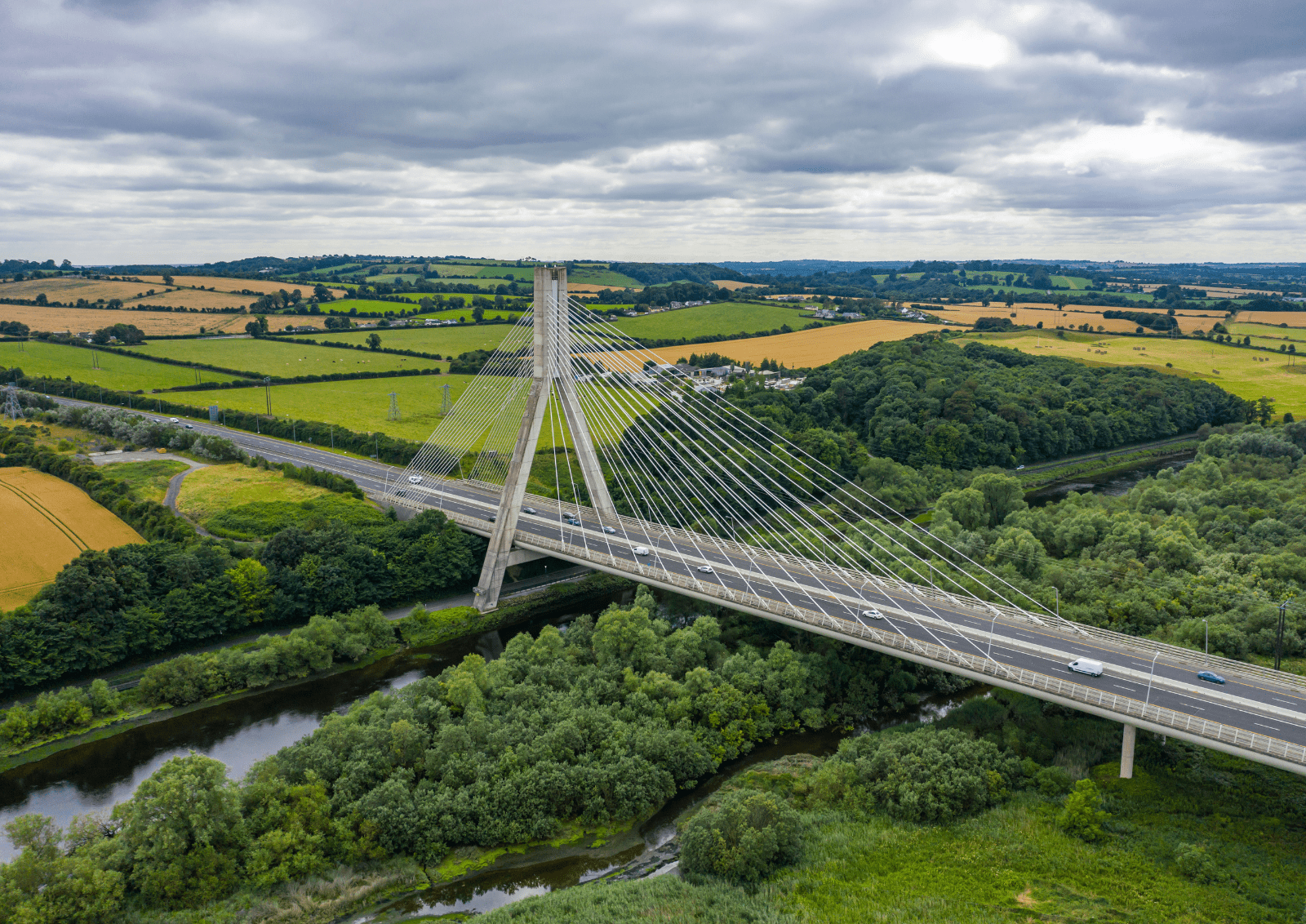
The Mary McAleese Boyne Valley Bridge opened in June 2003 and spans the River Boyne between Counties Meath and Louth as part of the M1 motorway.
Designed by Roughan & O’Donovan, the cable-stayed structure features a 95-metre-tall pylon and a 170-metre main span. This allows it to cross the river without piers and protects the sensitive environment below.
It was the first bridge in the world built using the incremental launching method for a cable-stayed design. This means the bridge deck was constructed in sections and gradually pushed out over the supports, reducing the need for scaffolding in the river.
It was renamed in 2013 to honour the former President Mary McAleese and is considered a landmark of Irish civil engineering.
13. Dunkettle Interchange
The upgraded Dunkettle Interchange was officially opened in February 2024, marking a major milestone in Cork’s transport infrastructure.
Located 5km east of the city centre, it connects four key national routes: the M8, N25, N40 and N8.
The €215 million project delivered 18 new road links, seven new bridges, and 2.9km of walkways and cycleways.
Built to ease congestion and improve safety, the interchange now handles up to 120,000 vehicles daily. Peak-hour journey times have also reduced by nearly 50%.
It’s considered a modern engineering feat and a catalyst for sustainable travel and regional development.
14. Rosslare Europort

Rosslare Europort’s major redevelopment began in late 2023, with phased construction continuing through 2025.
Located in County Wexford, the port has seen a surge in freight and passenger services to mainland Europe post-Brexit.
The €350 million masterplan includes new access roads, freight check-in areas, digitisation systems (e.g. self-check-in, automatic number plate recognition), and upgraded berths (moorings).
It also supports the development of Ireland’s Offshore Renewable Energy Hub, expected to create up to 2,000 jobs.
The project is designed to maintain full port operations during construction and will transform Rosslare into a smart, sustainable gateway to Europe.
15. Harland & Wolff dry dock

The Harland and Wolff dry dock, designed to build oil super tanker ships, opened in Belfast in 1968 after three years of construction.
Although the dock was a success in terms of construction, it never brought the financial returns that were hoped for, as the world’s ship building business had moved over to places like China and South Korea.
The dry dock is still in service today, mainly for ship maintenance.
Harland and Wolff are probably best known for having built many ships for the White Star Line – including the Titanic.
Plus, there’s a paint shop at the port that is now used as a film set. Scenes for 'Game of Thrones' were shot at the site!


Sustainable Development Goals:
You may also be interested in

- Type
- Civil Engineer blog
Linking data to value: 5 priorities from the ICG's data and digital benchmarking report
The Infrastructure Client Group's 2026 benchmarking survey shows progress, but greater focus is needed on value, data quality and delivery outcome.

- Type
- ICE Community blog
What's the foundation of flood resilience? Information
ICE President David Porter explains why being informed about flood risk is so important for the public and civil and infrastructure engineers.

- Type
- Awards and competitions
It’s electrifying! South Wales Metro track transformation bags top award
The electrification of the Core Valley Lines impressed the judges at the 2026 British Construction and Infrastructure Awards.