





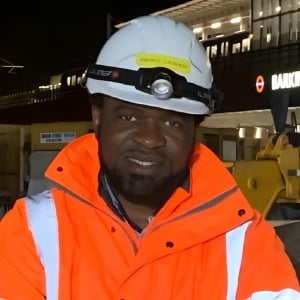
Dr Ohis Ilalokhoin
Engineering director, Cardinal Engineering
Expertise
Design, StructuralLocation
South EastMy highlights
Joining the ICE Trustee Board
Engineering lead on a number of critical infrastructure programmes like the Barking Riverside Extension and the Dover sea wall projects
Becoming a Fellow of the ICE
A day in my life…
My typical day is always varied, yet very exciting.
I would say my typical work week centres around three core areas.
First, I focus on providing technical leadership to our engineering teams across our respective projects.
Second, I spend a lot of my time meeting and engaging with current and potential clients, understanding their needs and how the team at Cardinal Engineering can add value to their business and help solve some of their most intricate challenges.
Thirdly, and probably one of the most rewarding parts of my typical working week, is the time I spend with the team at the ICE in my role as trustee, providing leadership and strategic direction for the institution’s learning society and safety risk portfolios.
I find this very rewarding as it provides me with the opportunity to make a tangible impact and add value to the engineering profession by using my time for a charitable purpose.
In today’s world, where engineers and infrastructure professionals work together as part of diverse teams, it's important that leaders get the best out of their teams.
Key to this is empathy, which is crucial for establishing the right relationships that enable teams to become high performing and flourish.
I would recommend a career in civil engineering because…
It’s a very rewarding career.
It's one of very few professions where you get the rare opportunity to be involved in the whole lifecycle of infrastructure delivery.
You take responsibility for creating concepts and figments of imagination and with the aid of science, help develop these into a plan on paper.
Then, you help drive these to realisation — creating the physical infrastructure which goes on to provide the crucial service that is necessary for uplifting the lives of many and the economy of nations.
For example, on the Barking Riverside extension project (which I led the engineering for), although a complex feat in its own right, the key satisfaction was the wider societal benefit it provided.
Successful commissioning of the line and the new rail station was a pre-requisite for unlocking the construction of about 10,000 new homes across east London.
So, today, thousands of Londoners have a place they call home because engineers helped deliver the necessary transport infrastructure that enabled this to happen.
Another example is closer to home to me. Every time I get on the train from where I live today, I do so using a station and rail platform that I was crucial to deliver as the multidisciplinary engineering lead several years ago.
For me, it couldn’t be more rewarding than that.
We asked Ohis
Which individual project or person inspired you to become a civil engineer?
I stumbled into studying civil engineering because of my now late uncle Frank.
He encouraged me to give it a try even though I was originally planning to study a different aspect of engineering.
But after a couple years of study, I was hooked and loved it.
But the inspiration to follow my current specialism was driven by two of my earliest mentors – Engr Chris Oyeka and Engr Mayne David-West – during my early formative years practising in Nigeria.
They were very influential in shaping the direction my career development and unrelenting in providing experience opportunities and training.
Both engineers have been two of the biggest influences on my career to date.
Complete this phrase: I’m a civil engineer, but I’m also…
I’m a civil engineer, but I also have a strong interest in gospel music.
I play the keyboard and bass guitar as part of a gospel band and have played since my teenage years.
Name one civil engineering myth you’d like to bust.
…the myth that civil engineering is too difficult.
While it's true that it can be challenging, and while I agree that potential engineers need to be smart, it's my strong view that with the right zeal, dedication and determination, it's not a difficult career to navigate.
Which civil engineering project (past or present) do you wish you’d worked on?
The Channel Tunnel Rail Link project.
It’s a great example of how the successful delivery of crucial transportation engineering projects, in this case, rail, can act as a great connector between nations and continents, driving socioeconomic benefits that transcends borders.
What do you think is the most important quality in a leader?
This may come as a strange one to many, but for me, one of the most important qualities in a leader is empathy.
In today’s world, where engineers and infrastructure professionals work together as part of diverse teams, it's important that leaders get the best out of their teams.
Key to this is empathy, which is crucial for establishing the right relationships that enable teams to become high performing and flourish.
What’s your #1 piece of advice for someone just starting their career as a civil engineer?
Be open-minded, inquisitive and willing to explore.
You don’t necessarily need to have all the answers before venturing into an endeavour, but with clear determination, you can succeed.
Most of all, make sure you are enjoying what you do.
What are the most important skills for civil engineers today?
- technically astute
- good organisational skills
- the ability to work as part of a team
Tell us how you work with people to create or foster diversity in the workplace.
I have seen firsthand, from personal experience, how diversity fosters productivity across high performing teams.
There's strength in diversity of thoughts and perspective.
Harnessing this can help infrastructure project leaders and teams achieve effective objectives.
Tell us how you work to address the problems caused by climate change.
Climate change is one of the biggest challenges we face in this generation and we all have a part to play.
An important part of the work we do at Cardinal Engineering is looking after old and ageing assets, getting more out of our existing infrastructure by reusing them and extending their lifespan rather than building new ones unnecessarily.
This helps reduce waste and improve the resilience of our critical infrastructure network, which aligns with the Sustainable Development Goals.
What do you think is the greatest challenge the industry is facing and how can civil engineers overcome this issue?
Some of the biggest challenges the industry is facing are skills and the changing role of the engineer in a more technology-driven world.
Engineers need to be open to training, retraining and continuing to evolve their knowledge throughout their careers through continuing professional development (CPD).
If they don’t, they risk becoming irrelevant in today’s rapidly changing world.
Any hobbies?
I enjoy the adventures of travelling and meeting people and exploring new cultures.
Ohis' career path
Education:
- Doctor of Philosophy (in complex networks), University of Oxford, UK
- Masters degree in major programme management, University of Oxford, UK
- Masters degree in civil engineering, University of East London, UK
- Bachelors degree in civil engineering, Ambrose Alli University, Nigeria
I'm engineering director at Cardinal Engineering, where I lead a team of engineers and infrastructure professionals to deliver complex infrastructure programmes across the UK and overseas.
I have been involved in the delivery of a number of notable projects in the UK including the Barking Riverside Extension project, the Four Lines Modernisation programme, the Piccadilly Line Upgrade programme, HS2, Crossrail, the Dover sea wall project, the London Power Tunnels programme, to name a few.
In the UK, earlier career experience involved working with Network Rail, Transport for London, Halcrow and Atkins.
My formative years were spent at Etteh Aro & Partners and Pearl Consultants in Port Harcourt, Nigeria and my experience here helped shaped the direction of my future career in civil engineering.




Related Content

- Type
- Civil Engineer blog
Building Safeguards report a year on: how the ICE has enacted its own recommendations
In July 2025, the institution published a plan to improve safety risk management. What progress has it made since then?

- Type
- ICE Community blog
What's the foundation of flood resilience? Information
ICE President David Porter explains why being informed about flood risk is so important for the public and civil and infrastructure engineers.

- Type
- Awards and competitions
It’s electrifying! South Wales Metro track transformation bags top award
The electrification of the Core Valley Lines impressed the judges at the 2026 British Construction and Infrastructure Awards.