





This form of renewable energy has a sea of potential but realising it won’t be without its challenges.
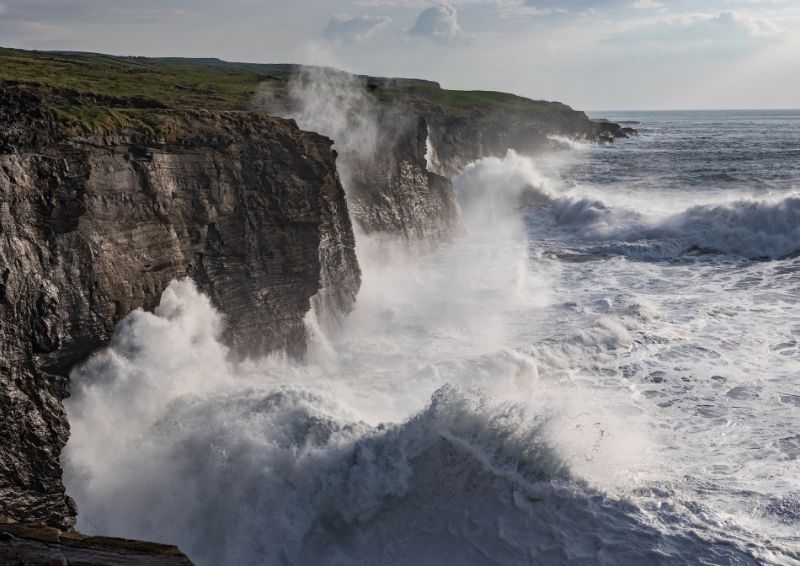
There’s nothing quite as soothing as hearing waves lap on the shore at that lulling, consistent rate.
Even if they pick up pace, or slam against the side of a cliff, there is something equally captivating about watching a force of nature in action.
What if we could use the strength of the ocean to our benefit? What if every crest of a wave powered the lights in our homes, businesses and schools?
Introducing wave energy
Wave power is a form of clean, renewable energy that harnesses the up-and-down motion of waves to generate electricity.
It uses devices that capture the movement of waves – technology that’s been in the works for decades, though it’s still at an early stage of development compared to solar and wind energy.
The first oscillating water column device, a type of wave energy technology, was built in Japan in 1965.
The UK government launched a major research programme into this form of energy in the 1970s, but very few examples of devices operating and producing electricity for the grid have emerged.
The best known are devices that have been tested as prototypes at the European Marine Energy Centre (EMEC) in Scotland.
However, by 2050, a mix of wave and tidal power (collectively known as marine energy) could produce 300GW of renewable energy globally, says Ocean Energy Systems, an intergovernmental collaboration programme.
That’s enough to power around 150 million homes.
How does wave energy work?
Waves are formed by wind travelling over the surface of the sea. The stronger the wind, the larger the wave.
Larger waves carry more kinetic energy (energy from movement), which turns into electricity by using turbines and generators.
The way this is done varies by the technology used. According to the EMEC, there are eight main options:
- Attenuators – attenuators are long, jointed steel structures that float on the ocean, generating power when swells flex their joints.
- Point absorbers – these huge buoys are fixed to the seabed. When their floating top moves up and down, it pulls pistons which then turn the generator to create electricity.
- Oscillating wave surge converter – also fixed to the seabed (or another structure), these devices have a hinged arm or plate that moves back and forth as the waves pass through it, driving a generator. Floating variations also exist.
- Oscillating water columns – these partially submerged, hollow columns work by compressing air and using it to turn a turbine. Waves press air into a chamber, and as it rises, it turns the turbine. When the wave withdraws, the air comes back out, passing through the turbine again.
- Overtopping devices – these structures trap water in a reservoir placed above sea level, which is then returned to the ocean through a turbine to generate electricity.
- Submerged pressure differential devices – normally located near the shore, these devices harness the difference in pressure caused by the sea level rising and falling. The changing pressure pumps a fluid through the system to generate electricity.
- Bulge wave devices – these rubber tubes are secured to the seabed, allowing water to enter at the front and move through its body, causing pressure to vary along its route. This pressure creates a ‘bulge’ which grows as it travels, gathering energy that can turn a turbine on its way out the tube.
- Rotating mass system – these devices rotate a gyroscope or a moving weight to power a generator that creates electricity.
Advantages and disadvantages of using wave energy
Pros of using wave power
- It’s completely renewable
- It doesn’t generate any greenhouse gas emissions, so it’s also clean
- It doesn’t release pollution into the sea
- It can produce electricity locally, helping to supply remote areas like islands or boats
Cons of using wave power
- The upfront costs are high and uncertain – a single 750kW attenuator device has been estimated to cost around €7.5 million, while a 250kW point absorber is expected to cost approximately €1.5 million
- Installation is challenging, as it must be done in high winds and among large waves
- The technology can impact local marine ecosystems
- It could also potentially obstruct shipping lanes
- Some people feel the technology can be unattractive to look at
- It’s not entirely reliable, either, as the strength of the waves depends on the wind
Other challenges of using the technology include:
- The technology is still in early development stages
- Wave energy sites are some distance offshore and require large transmission cable lengths – this can also make maintenance more costly
- There are gaps in terms of the infrastructure needed to operate it efficiently (electricity grid connections, ports and supply chains)
- Competition from other renewables, such as wind and solar, which have scaled up very quickly
These challenges may deter investors, who may choose to invest in other, more tried and tested, renewable options.
Go with the flow: global use of wave power
Australia currently houses 200 wave energy devices in various stages of development. This includes the Perth Wave Energy Project, which was the first commercial-scale plant connected to the power grid.
It’s estimated wave energy could cover 11% of Australia’s energy needs by 2050.
South Korea is also investing in wave energy research, with multiple test sites and pilot projects along its coastline.
Similarly, China has been experimenting along its 14,500km coastline. In 2023, a wave energy converter called Nankun began operations in Zhuhai, in the Guangdong province.
In South America, Chile has led the way by installing the first test wave energy converter in the region in 2021. The country has a lot of potential for deploying this energy due to the strong and consistent wave patterns in the area.
The UK is moving towards its first commercial wave farm. In 2025, a developer called CorPower Ocean agreed to build a 5MW wave energy project in Orkney, Scotland (enough to power over a thousand homes).
The UK government also launched a Marine Energy Taskforce in 2025, which will work to develop a pathway for the country to realise its marine energy potential.
The future of wave power
Wave energy holds a lot of promise – the ocean is a significant resource.
But there are still a lot of challenges to overcome in order to generate electricity and transmit it to shore.
It’s likely that other types of marine energy – such as tidal power – will be prioritised.
Still, wave power can help strengthen the energy mix, making it more resilient and robust.

You may also be interested in

- Type
- Civil Engineer blog
Linking data to value: 5 priorities from the ICG's data and digital benchmarking report
The Infrastructure Client Group's 2026 benchmarking survey shows progress, but greater focus is needed on value, data quality and delivery outcome.

- Type
- ICE Community blog
What's the foundation of flood resilience? Information
ICE President David Porter explains why being informed about flood risk is so important for the public and civil and infrastructure engineers.

- Type
- Awards and competitions
It’s electrifying! South Wales Metro track transformation bags top award
The electrification of the Core Valley Lines impressed the judges at the 2026 British Construction and Infrastructure Awards.