





ICE Knowledge Hub
Access the very latest and best CPD content to help you grow your knowledge and skills.
Sign in now

Traffic engineers Mark Omar Mohsen and Steve Jones explore how innovative road designs can keep people safe and reduce congestion.
Road crashes kill approximately 1.19 million people worldwide every year. Between 20-50 million more are injured.
Around the world, cities are embracing new designs that prioritise safety and accessibility for every road user, including motorists, cyclists and pedestrians.
From Vision Zero to the Safe System Approach adopted across the UK, Europe, Australia, Malaysia, and more, the global movement is clear.
Road design must minimise the chance of severe crashes, not just manage traffic flow.
Vision Zero is built on a simple principle: no loss of life on the road is acceptable.
It recognises that people will make mistakes and thus designs road systems and policies (i.e. regulating speed) that take this into account to prevent severe injuries or death.
The Safe System Approach starts from the position that there is no acceptable level of road deaths or serious injuries.
Importantly, it opposes the often-cited claim that driver error is the cause of 90% of road fatalities.
“At best, driver error is the last failure in a causal chain of events leading to a crash,” according to the International Transport Forum. Other factors include designed weaknesses in vehicles and infrastructure.
Only focusing on user error could mean systemic failures are not addressed.
Alongside policy (such as speed management), road design has an essential part to play in keeping people safe.
Every road and junction must fulfil their intended purpose while preventing conflicts between users and supporting safe behaviour.
Safe road design should reduce the likelihood of crashes, and where they do happen, minimise the risk of injury.
Junctions, where two or more roads meet, often see the most accidents.
In most countries, 40-60% of accidents happen at junctions, according to the European Commission.
As such, traffic engineers must think carefully of when and where to use them, which type to use and how to implement them to reduce the risk of crashes.
This can get more complicated when you consider several modes of transport, such as rail, cycling or walking.
If all need to cross the same junction, how do you make space for them?
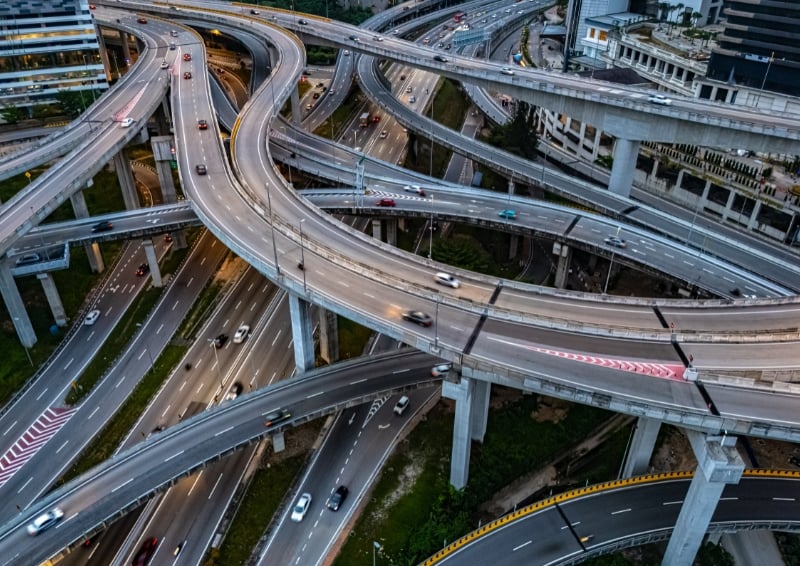
There are many different types of junctions, from intersections (on one level) to interchanges (on several levels – like the Spaghetti Junction), and from diamond shapes to four-leaf clovers.
Across the world, road designers are looking for ways to make these junctions safer and more people-focused, all while managing congestion.
An example of such a design is the XT junction, a re-imagined version of the T junction, where a minor road joins a major one.
An XT junction swaps the opposing streams of traffic on the minor road – creating the X in XT – to allow unopposed right turns at the main junction.
This swap improves safety and efficiency for all users, and is particularly effective for busy urban contexts, where the traditional T junction layout can struggle.
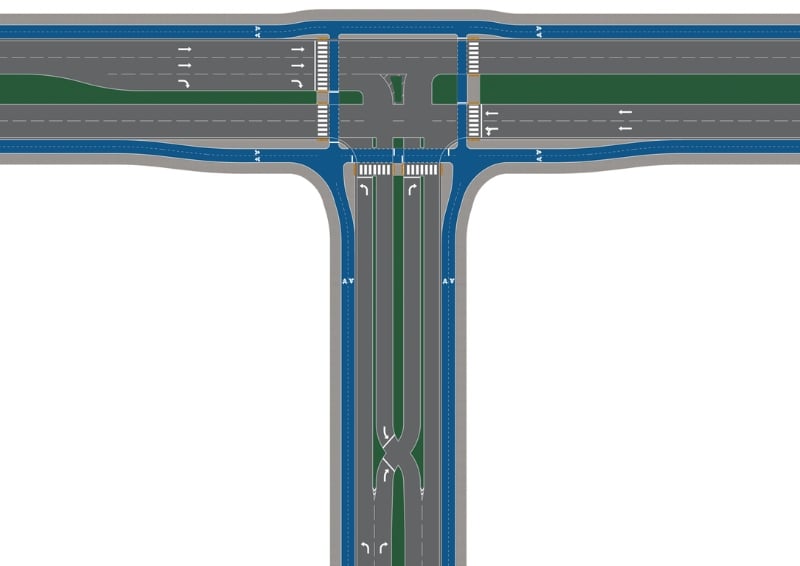
The XT junction design focuses on:
The XT junction is still at conceptual stage.
As part of developing the junction, around 200 participants watched a short video explaining its layout, benefits, and limitations.
Their responses were positive:
This shows that with simple explanations and user-friendly materials, people can quickly understand how to navigate new layouts.
So how do we move the XT junction from concept to reality?
Unique solutions, if hidden, are easily overlooked.
The XT junction shares similarities with some continuous flow intersection (CFI) concepts. But grouping it under that broad umbrella can hide what makes it special.
Giving the XT junction a clear identity is a crucial first step toward unlocking its wider use.
The success of past designs – such as the diverging diamond interchange (DDI) –shows the value of having a simple name that all stakeholders can easily recognise.
Cities everywhere are looking for ways to make their streets more people-focused while managing congestion.
The XT junction supports both goals by improving safety and traffic flow without requiring major reconstruction or new land.
By giving the XT junction a clear identity and encouraging more research, the design could move from a lesser-known idea to a recognised solution.
The key to safer, multimodal traffic may already be hidden in plain sight.

The Infrastructure Client Group's 2026 benchmarking survey shows progress, but greater focus is needed on value, data quality and delivery outcome.

ICE President David Porter explains why being informed about flood risk is so important for the public and civil and infrastructure engineers.

The electrification of the Core Valley Lines impressed the judges at the 2026 British Construction and Infrastructure Awards.

