





University of Leeds’ Professor Fleur Loveridge, Associate Professor Emma Bramham and Professor Simon Rees explore the uses, benefits and challenges of this renewable source.
Did you know that the ground beneath your feet has the ability to warm your house in the winter, and even keep it cool during the summer?
It may sound counterintuitive, but the technology exists, and as we move towards net zero, it’s becoming more common.
What is geothermal energy and how does it work?
Geothermal energy refers to the use of thermal energy (heat) from below the Earth’s surface. It can heat and cool buildings or generate electricity.
It comes from one of two sources:
- Near the surface (upper 10s of metres), the ground stores heat from the sun
- Deeper underground, temperatures rise naturally the further down you go, around 2-3°C per 100m (this is due to radioactive processes that take place in the Earth’s core)
How quickly the temperature increases with depth depends on where you are in the world.
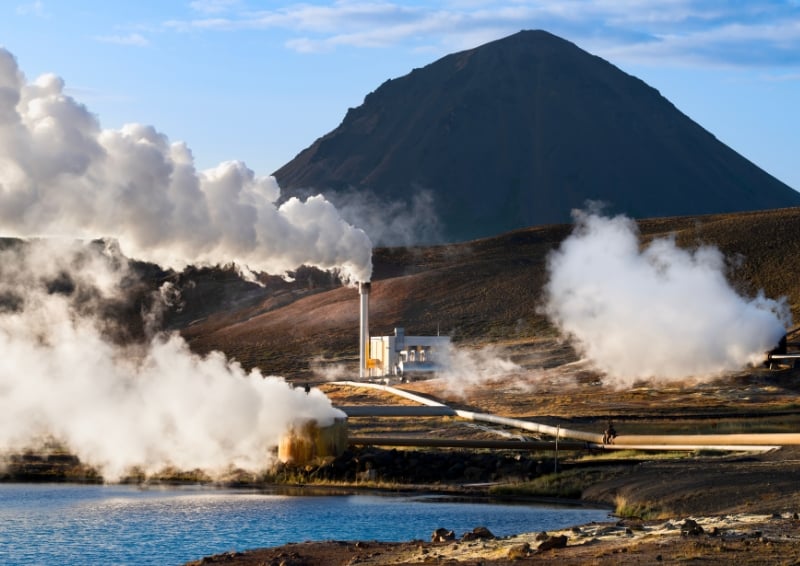
In volcanic regions such as Iceland, this heat is closer to the surface (around 10-20°C per 100m), making geothermal energy easier to access.
How is geothermal energy used?
There are several ways to use geothermal energy, depending on the location, the temperatures available underground, and how deep a system is drilled.
Deep geothermal: electricity and heat networks
Generating electricity from geothermal power requires temperatures high enough to extract water from the ground as steam that drives turbines. This is only feasible at specific locations.
Traditionally, power plants have been developed where, near the surface, there are rocks that allow hot water to flow. These are called hydrothermal systems.
This usually limits locations to regions above tectonic plate boundaries or volcanic hotspots such as Iceland.
Enhanced geothermal systems (EGS)
In most places that do have high enough temperatures within drilling-reach, the rocks don’t allow water to flow through as well.
In these cases, an enhanced geothermal system is required to extract heat.
EGS inject high-pressure fluids during construction to open new ‘cracks’ within the rock and allow water to circulate and generate steam.
The recently opened United Downs deep geothermal power plant in Cornwall, UK is an example of this approach.
Shallow geothermal: heating and cooling buildings
Where the accessible temperatures beneath the earth are lower, geothermal energy can still heat and cool our buildings.
In fact, most geothermal systems in the UK are used for this purpose.
These systems may be:
- Closed loop: where fluid (water and antifreeze) circulates through sealed plastic pipes in the ground; or
- Open loop: where natural groundwater is pumped through a heat exchanger (this requires aquifers, or highly permeable layers).
In both cases, a heat pump raises the temperature of the fluid or groundwater to a level suitable for indoor heating.
The heat pumps use refrigeration technology, which means they can also be used for cooling. What happens is excess heat is transferred back to the ground to be stored over the summer and used again in the winter – improving efficiency and sustainability.
This underground storage can also use other sources of waste heat, such as from supermarket chillers, industrial processes, or data centres.
At certain depths, provided the ground temperature is hot enough, geothermal systems can warm homes directly, without a heat pump.

Other technologies
Other shallow geothermal technologies include using flooded mines, foundations, tunnels and other underground structures, which can reduce drilling costs. These are closed-loop systems.
Examples include the Gateshead mine water district heating scheme and the deep-piled foundations for the One New Change development in the City of London.
Is geothermal power renewable?
Electricity generated from geothermal power plants is renewable.
Where geothermal energy is used for heating, the source is renewable, but not unlimited.
The heat underground will recharge naturally, but it needs to be used at a sustainable rate to ensure we don’t use it up before it can replenish.
This is especially true for heating from shallow geothermal systems. At greater depths, where temperatures are higher, this is less of an issue.
It is also worth noting that the overall system is only renewable if the electricity used to supply the heat pump is also renewable. Hence, this is why geothermal is often called a low-carbon solution, rather than zero carbon.
What are the advantages and disadvantages of using geothermal energy?
Benefits
- It’s local and renewable, reducing the need to import fuels
- It’s reliable – electricity can be generated continuously, and heating/cooling delivered year-round
- It’s decarbonisation-friendly: as we step away from fossil fuels, more pressure will be placed on the electricity grid to deliver heating and cooling. Geothermal heating will help to balance this demand, reducing the amount of work and investment needed to adapt the grid
- It will help lower energy bills – the more heat and power geothermal can provide, the less we’ll rely on the oil and gas market (which currently sets the price of energy). This will ultimately make our bills cheaper
Challenges
One of the main challenges of developing geothermal energy is understanding the conditions beneath the surface.
This means managing uncertainty during planning, design, construction and operation.
Shallower closed-loop heat pump systems, which don’t rely on the type of geology, can be deployed anywhere and come with very little risk.
However, if the system relies on particular ground conditions, like permeable aquifers, there are greater risks to developing a successful project.
This risk increases with depth.
Not as much is known about geological conditions the deeper one goes, and so initial exploration costs are higher.
As well as careful design, these systems also require active monitoring and management to ensure temperatures remain at appropriate levels
Enhanced geothermal systems also run the risk of generating very small earthquakes, which requires careful regulation and public engagement.
Advanced geothermal systems (AGS)
Advanced geothermal systems are an alternative option for generating electricity.
Currently being explored in Germany and Canada, they consist of deep closed-loop networks that provide access to high temperatures without needing to create cracks in the rock. However, drilling deeper means higher costs.
An added benefit: rare earth minerals
In the UK, where suitable temperatures for geothermal energy are present, lithium is often found.
This critical mineral is essential for battery production and therefore at the centre of the energy transition.
Water extracted from deep geothermal boreholes may also contain dissolved lithium compounds.
This helps make deep drilling more commercially viable.
![Different types of geothermal energy. Image credits: University of Leeds (Barns et al (2026) Affordable, secure and clean energy: The case for geothermal. Brief No.14, Policy Leeds, University of Leeds. <a href="https://doi.org/10.48785/100/467">https://doi.org/10.48785/100/467</a>) and British Geological Survey (reproduced with the permission of the British Geological Survey © UKRI [2026]. All rights reserved)](/media/zcjlvosu/different-types-of-geothermal-power-bga-and-uol.jpg)
Will deep geothermal energy have a big part to play in the UK?
Deep geothermal power is likely to remain relatively niche in the UK, but it will still be able to play important local roles.
However, heating and cooling from shallow systems (closed and open loop) have the potential to be adopted across much of the UK.
This type of geothermal technology is low risk and the energy availability is well matched with population centres and the greatest heating demand.
With around one quarter of UK carbon emissions still related to heating buildings, geothermal heat pump systems will be essential to contribute to decarbonisation.
While installation costs can be higher than air-source heat pumps, geothermal systems have lower operating costs and are more efficient.
Why is deep geothermal power limited in the UK?
The UK is not blessed with widely accessible hot rocks or active volcanic regions such as those in New Zealand or Iceland.
This means that geothermal power will require very deep drilling, which is expensive and high-risk.
Projects like United Downs in Cornwall show that it is possible, but not yet easy to scale. Drilling to 5km depth, as was the case for this project, is technically difficult and a highly specialised activity. That comes with high costs.
Taking the United Downs project through investigation, construction, and grid connection has cost £50m.
Has geothermal energy been embraced elsewhere in the world?
There’s over 7,000 MW of geothermal power capacity installed in Europe. It’s mainly concentrated in Turkey, Iceland and Italy, where geological conditions are better suited.
The United Downs project by comparison is limited to 3 MW.
Note: 1MW can power around 2,000 UK homes per hour (Ofgem)
There are currently around 2.4 million geothermal heat pumps installed across Europe.
Around 55,000 were estimated to be installed in the UK in early 2024, delivering 860 MW of thermal capacity.
The installation rate grew by 32% in 2025 when 125,000 heat pumps of all types were installed in the UK – still a long way short of the government target of 450,000 per year.
Heat pumps adoption is expected to be strongly driven by the UK Future Homes standard requirements for new housing construction.
Increasing fossil fuel prices across the globe will only act to accelerate this transition.



Sustainable Development Goals:
You may also be interested in

- Type
- ICE Community blog
What's the foundation of flood resilience? Information
ICE President David Porter explains why being informed about flood risk is so important for the public and civil and infrastructure engineers.

- Type
- Awards and competitions
It’s electrifying! South Wales Metro track transformation bags top award
The electrification of the Core Valley Lines impressed the judges at the 2026 British Construction and Infrastructure Awards.

- Type
- Civil Engineer blog
The long-term consequences of a really good idea
Good decisions made at speed can lead the industry down unintended paths, writes Steven Yule, ICE country representative for the UAE.