





ICE Knowledge Hub
Access the very latest and best CPD content to help you grow your knowledge and skills.
Sign in now

CROSS aims to help create a safer built environment by improving competence through the sharing of technical knowledge, and by encouraging more open and collaborative attitudes.
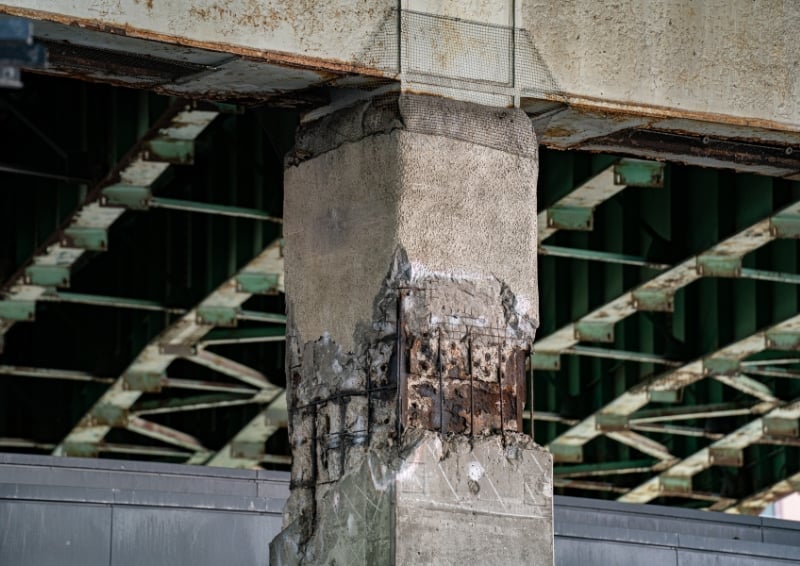
It’s a sad fact that many people only hear about infrastructure when something goes wrong.
A dramatic collapse will capture attention, but the small cracks, loose bolts or corroded joints that came before may go unnoticed.
For 20 years, CROSS-UK (Collaborative Reporting for Safer Structures UK) has provided a scheme for professionals to raise concerns anonymously when they spot something that isn’t right.
Going over safety reports from the last two decades, we’ve identified five common themes that show why warnings – and learning from them – really matters, with examples for each.
A cinema ceiling collapsed because it hadn’t been built to the required specification – from the wrong nail length to poor perimeter connections, meaning it wasn’t properly tied into the support system.
Two mobile phone roof towers fell after a storm because the epoxy anchors holding them in place came loose.
Though the anchors were installed within the ambient temperature limit, they had been left in direct sunlight on a hot roof prior to installation. This caused them to overheat beyond their usable range.
The top part of an offshore lattice mast failed because of issues with some of the connection bolts. The reporter’s concern was that this part of the structure had been designed to withstand wind but not wave loading (like the rest of the tower).
A building control officer spotted a recurring calculation error, later traced to a flaw in the design software.
The reporter was concerned that these mistakes weren’t picked up before the design was submitted.
The report recommends checking and validating all design output from proprietary (own) software.
Several columns for an eight-storey building were missing from the drawings generated from a BIM model, passing through to construction without the error being identified.
Several arches from an undercroft (typically a basement with vaulted arched ceilings) were demolished without fully considering how the remaining elements and nearby structures would behave.
This led to what the reporter believed to be a “very dangerous” situation, as only one arch was left standing.
Demolition works require as much competence as building new.
A building owner wanted to add more solar panels to a roof that was already considered to be overloaded by a competent inspector. It risked collapse under the weight of a heavy snowfall.
Timber hoarding, a temporary barrier built around construction sites, failed and struck a worker during a windy day.
The fixings (i.e. connections) couldn’t be inspected post-installation, raising concerns about how temporary works were designed and checked.
A qualified temporary works designer/manager should be involved.
When cracks on a historic church were initially attributed to bell vibrations, demolition was considered.
To save the building, the community asked a structural professional to take a look. They found that the bells were unlikely to be responsible, and as such, restoration was chosen over demolition.
Concerns were raised about an unqualified individual being appointed to inspect highway assets such as roads and tunnels due to staff shortages.
Underfunding or understaffing the maintenance of these assets carries significant risk.
Stone cladding fell from a church after steel supports corroded and expanded behind the facade – an important reminder that risk can develop out of sight.
A reporter wrote in with concerns about the structural safety of streetlight columns in their area.
Wind, rain and even animal urine can corrode these structures, all of which needs to be considered early in the design process.
A crack in a 1920s decorative ceiling led to an inspector finding out that the hessian (hemp/jute) hangers supporting the plaster had degraded over decades.
The reporter suspected that had the ceiling been flat instead of arched, it would have collapsed.
Upon checking a leaky roof, cross-laminated timber (CLT) panels with severe rotting in some areas were found.
CLT will rot when too much moisture is present over long periods of time.
It’s believed that water may have entered during construction. However, it may also be attributable to condensation or defects in the roof’s waterproof membrane.
Severe corrosion was found in steel columns that formed part of the structural frame of a public pool hall, even after previous repair work.
Design, maintenance and inspection regimes should account for the potential for high-moisture environments to speed up deterioration beyond expected rates.
A report warned that smoke and fire can rapidly spread through poorly designed or installed service ducts hidden inside buildings.
If these ducts are altered in any way for maintenance (i.e. repairing electrics), it’s crucial that the fire stopping element is appropriately repaired.
A reporter is concerned that not enough thought is being put into the choice to use mineral wool for cladding insulation.
Often chosen for its higher fire resistance, mineral wool can increase the load on cladding fixings due to its increased thickness and weight.
It can also retain more moisture, which, if not detailed well, could lead to corrosion of the supporting structure or cladding fixings.
As the use of lithium-ion batteries increases, a reporter raises concerns about fire risks and the lack of research and guidance.
With only limited guidance available, the advice is to consult a competent fire safety engineer if a project involves battery systems.
Students moved into accommodation before key fire safety systems were fully in place, prompting urgent enforcement from the regulator.
Deadlines (such as term dates) and commercial pressure should never override safety requirements.
Bio-based materials such as bamboo are being used more widely, but concerns remain over fire testing standards and long-term performance.
There are many reasons as to why a building might fail or why a fire might start.
Human errors. Lack of communication. Unclear responsibilities. Inadequate record keeping. Design changes. Equipment failure. Construction and material deficiencies. Overloading. Misuse. Lack of maintenance.
The crucial part is learning from these so that the industry can prevent future failures.
That's what CROSS-UK is all about.


Ingrid Valceschini, associate director at Buro Happold, ICE Fellow and professional reviewer, reflects on how technicians contribute to successful project delivery and why the profession must continue to evolve.

Candidates who meet the requirements are invited to stand to represent the institution as a future president of the ICE.

The Infrastructure Client Group's 2026 benchmarking survey shows progress, but greater focus is needed on value, data quality and delivery outcome.