





From bridging remote regions to harnessing natural resources, these feats of engineering reflect Scotland’s rich heritage, innovation, and commitment to progress.

Scotland is home to some of the most remarkable civil engineering projects in the world.
These projects have not only shaped the landscape but also transformed the lives of the communities they serve.
From bridging remote regions to harnessing natural resources, these feats of engineering reflect Scotland’s rich heritage, innovation, and commitment to progress.
In no particular order:
1. Cox’s Stack

Rising 282 feet above Dundee, Cox’s Stack is Scotland’s tallest surviving industrial chimney and a proud symbol of the city’s jute heritage.
Built in 1866 for the Cox Brother's’ Camperdown Works (the largest jute mill in the world at the time), it showcased the scale and ambition of Dundee’s industrial era.
Designed by architect James Maclaren and engineer George A Cox, the chimney combines functionality with Victorian engineering flair.
Its height helped disperse smoke and ash away from the factory floor, improving air quality for thousands of workers.
Though the mill closed in the 1980s, Cox’s Stack remains a proud monument to Dundee’s industrial past.
2. Brig O’Doon
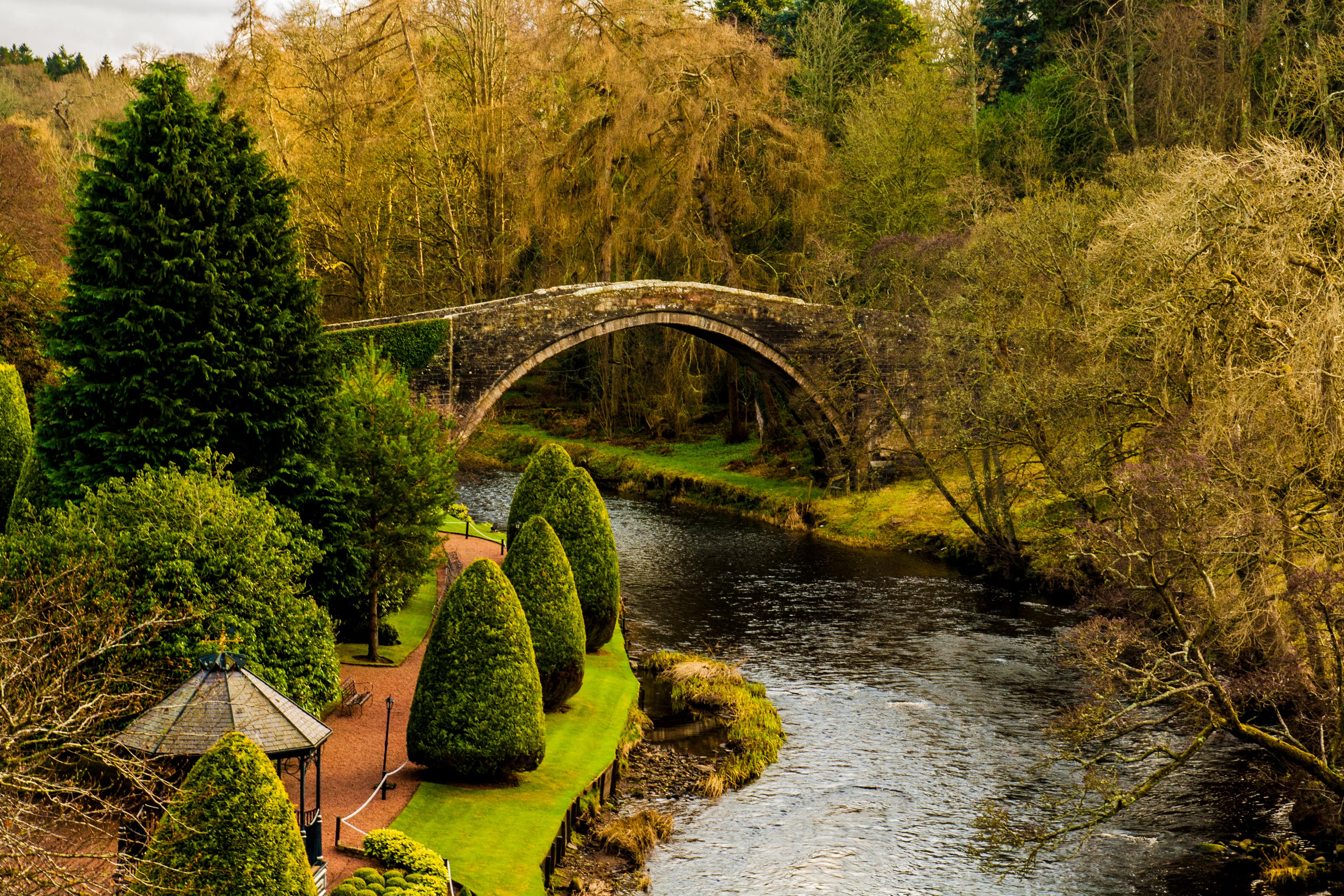
The Brig O’Doon is a 15th-century stone arch bridge that spans the River Doon near Alloway, Ayrshire.
Its single arch and cobbled pathway were designed to withstand the river’s flow and the test of time.
Beyond its visual appeal, the bridge holds a special place in Scottish culture thanks to its immortalisation in Robert Burn’s ‘Tam O’Shanter’.
In the poem, the bridge becomes a dramatic escape route for protagonist Tam, who was being pursued by witches.
Originally built to connect rural communities to the market town of Ayr, the Brig O’Doon has been preserved through local efforts.
It now sits beside the Robert Burns Birthplace Museum and remains a cherished landmark to this day.
3. Forth Bridge

Opened in 1890, the Forth Bridge is a landmark of global engineering significance.
Spanning the Firth of Forth with its bold cantilever design, the bridge stretches over 2.5km and was the first major structure in Britain to be built entirely of steel.
Designed by Sir John Fowler and Sir Benjamin Baker, the bridge was a response to growing railway demands.
It set new standards for safety and durability as its innovative structure was built to withstand the harsh Scottish climate.
It remains in active use today, carrying rail traffic between Edinburgh and Fife.
In 2015, the Forth Bridge was designated a UNESCO World Heritage Site.
4. Forth Road Bridge

Opened in 1964, the Forth Road Bridge connects Edinburgh and Fife across the Firth of Forth.
At the time, it was one of the longest suspension bridges in the world – with a main span of over 1,000 metres and a total length of 2.5km.
Designed to replace an ageing ferry service, the bridge revolutionised travel and commerce in the region by improving journey times and accessibility.
It quickly became a vital transport link, carrying tens of thousands of vehicles daily.
Engineered and built to withstand the harsh coastal environment, the bridge was a triumph of mid-20th-century design.
Today, the Forth Road Bridge serves as a dedicated public transport corridor for buses, cyclists, and pedestrians.
5. Queensferry Crossing

Opened in 2017, the Queensferry Crossing is the longest three-tower cable-stayed bridge in the world.
It’s the centrepiece of Scotland’s major transport corridor between Edinburgh and Fife.
Spanning 2.7km across the Firth of Forth, it was built to relieve pressure on the ageing Forth Road Bridge and ensure long-term resilience for cross-Forth travel.
The bridge features 23,000 miles of cabling and innovative wind-shielding to withstand winds speed up to 70mph.
It was one of the largest infrastructure projects in the UK in recent decades, delivering with a strong focus on safety, sustainability and durability.
Now carrying around 24 million vehicles per year, the Queensferry Crossing stands alongside the Forth Bridge and Forth Road Bridge – three generations of engineering excellence in one location.
6. Glenfinnan Viaduct
Completed in 1898, the Glenfinnan Viaduct is a pioneering feat of Victorian engineering and the longest concrete railway bridge in Scotland.
Stretching 416 yards across 21 arches and rising 100 feet above the River Finnan, it was the first large-scale concrete viaduct built in Britain.
It was constructed without reinforcement, a bold innovation at the time.
Built by Robert McAlpine & Sons, earning McAlpine the nickname “Concrete Bob”, the viaduct formed part of the West Highland Railway. It links Fort William to the fishing port of Mallaig.
The connection helped boost the local economy by enabling fresh fish to reach London markets within a day.
Today, the viaduct is world-famous for its scenic beauty and cultural significance.
It’s best known as the route of the Jacobite steam train, featured as the Hogwarts Express in the Harry Potter films.
7. Falkirk Wheel

Opened in 2002, the Falkirk Wheel is the world’s only fully rotating boat lift.
Built as part of the £85 million Millennium Link project, it reconnected the Forth and Clyde Canal with the Union Canal.
Standing 35 metres tall, the wheel uses two gondolas to lift boats 24 metres in a smooth, energy-efficient rotation based on Archimedes’ principle.
When a boat enters one gondola, an equal weight of water spills out into the canal, ensuring that both gondolas, one with a boat and one with just water, always weigh the same.
Each gondola can hold up to 500,000 litres of water (the equivalent of an Olympic swimming pool) and the entire lift uses less energy than boiling eight kettles.
Designed to last 120 years, the structure was assembled from 1,200 tonnes of steel and over 15,000 hand-tightened bolts. It was constructed in Derbyshire, transported in 35 lorry loads, and reassembled onsite in Falkirk.
Since its opening by Queen Elizabeth II, the Falkirk Wheel has welcomed over 5.5 million visitors, boosting tourism and reconnecting communities.
8. V&A Dundee

Opened in 2018, the V&A Dundee is Scotland’s first design museum and a striking example of how architecture and engineering can transform a city.
Designed by Japanese architect Kengo Kuma and engineered by Arup, the building anchors Dundee’s waterfront regeneration and draws inspiration from the cliffs of Scotland’s northeast coast.
The building is made up of 2,429 precast concrete panels, each uniquely shaped and mounted using bespoke brackets to create a cliff-like texture.
The structure functions like a shell, with the roof, walls, and floors working together to provide stability.
Built partly over the River Tay, sustainability was central to the project, with ground and air source heat pumps providing renewable energy for heating and cooling.

You may also be interested in

- Type
- ICE Community blog
What's the foundation of flood resilience? Information
ICE President David Porter explains why being informed about flood risk is so important for the public and civil and infrastructure engineers.

- Type
- Awards and competitions
It’s electrifying! South Wales Metro track transformation bags top award
The electrification of the Core Valley Lines impressed the judges at the 2026 British Construction and Infrastructure Awards.

- Type
- Civil Engineer blog
The long-term consequences of a really good idea
Good decisions made at speed can lead the industry down unintended paths, writes Steven Yule, ICE country representative for the UAE.