


Resilient Transport
Join industry leaders in Manchester this September to explore practical solutions for building stronger, more adaptable networks.
Be part of the shift

At the July meeting, council heard from the trustee for carbon and climate change about the ICE resilience programme, external experts on AI and emerging technology, and discussed our engineering knowledge landscape review.

The ICE Council is the voice of the membership, and it performs an invaluable advisory role for the ICE Trustee Board.
I was therefore delighted to open the third council meeting of the 2025 to 2026 session by congratulating all of the recently elected and re-elected members of the council. I look forward to working with you all.
Adrian Johnson, executive technical director at Stantec, provided an update on PAS 3090 – adaptation pathways for infrastructure systems. He outlined that the PAS, which is a publicly available specification published through the British Standards Institution (BSI) in the UK, will cover:
The latest draft has been reviewed by the BSI steering group and the ICE’s technical advisory panel. Public consultation is due to open in September with a view to publishing the PAS alongside the guidance document in April 2027.
Linked to PAS 3090, Paul Shaffer, director of innovation and delivery at the Chartered Institution of Water and Environmental Management (CIWEM), gave a presentation on sustainable drainage systems (SuDS) and the role they can play in flood risk management and ecosystem creation.
He referred to Schedule III of the Flood and Water Management Act 2010, which enables local authorities to mandate sustainable drainage. He noted that while this had been implemented in Wales, it had not yet commenced in England and remained a challenge.
Paul highlighted the need to get multiple partners involved in raising the profile of SuDS and the need to ensure that those involved in projects had consistent and up-to-date guidance and training. Promoting SuDS aligns with the ICE’s commitment to support climate change mitigation.
Mark Coates from Bentley Systems and Nasrine Tomasi from Mott McDonald shared the presentation that they gave at the trustee board strategy day in February.
They explained that the level of understanding of AI and skill in using it differs across all organisations, with early professionals often being early adopters, and driving innovative use.
Upskilling is therefore imperative to ensure more people are aware of the opportunity that AI and other emerging technologies offer, and that those who are approving work are able to accurately assess anything designed using AI tools.
It was highlighted that AI had the potential to significantly increase productivity within the industry but that not all AI is equal and we need to be clear about the different types, and the pros and cons of each.
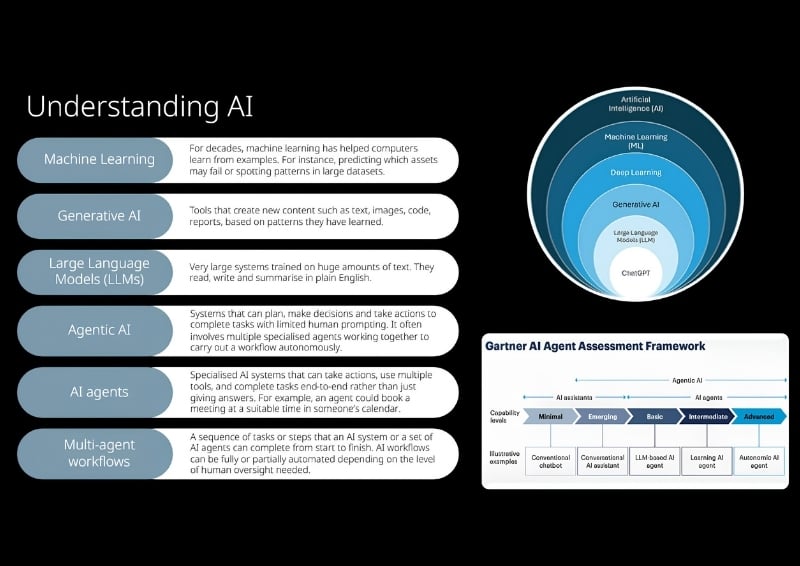
AI can already be used for more mundane tasks, but it is important that we must not take away the need for human oversight and accountability.
The message was clear: AI should be embraced and used as a tool but the information coming out is only as good as what goes in. As such, we need training to ensure people know how to use AI, and there needs to be checks in place to ensure we can trust what comes out.
The director of policy and external affairs and the knowledge services director talked through the plan to review the structure of ICE committees and the delivery of the engineering knowledge programme, which was approved at the last trustee board.
The review will focus on the member-led groups which sits beneath the principal committees that are involved in knowledge generation. This will cover engineering knowledge, membership, and policy and external affairs.
The aim is to ensure that the ICE’s knowledge aligns with the three pillars of the new strategy: trusted, sustainable and intelligent infrastructure.
To help inform the review, council members were asked a number of questions related to their roles on different committees and the ways in which they consume knowledge content from the ICE and other organisations.
The feedback from those discussions will be shared with the review working group who are to report back in Q1 2027.
In the 2024 State of the Nation report, we said that ICE members should be leaders when it comes to decarbonisation, a point reflected in our 2025 to 2030 strategy.
The trustee for carbon and climate, Lewis Barlow, talked about the work being done in this area to ensure we live up to that goal:

A presentation from the architect, structural designers, fabricators and the principal contractor that delivered this unique structure. The discussion details how the bridge developed from concept design through to installation including the use of one of the largest cranes in the UK for the bridge …

The extreme climates experienced this year - and their impact on our infrastructure - raises important questions.

ICE Panel debate: Can we afford to delay climate readiness?
Launch of the ICE’s latest policy paper “Making resilience count: The economic value of climate readiness”.
You will join a dynamic discussion to explore recommendations for embedding re…