





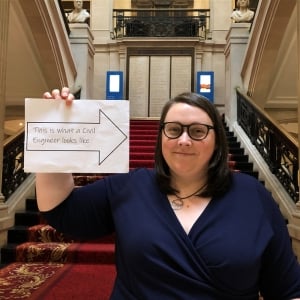
Jemma Quin
Temporary works manager at Robertson Construction Group and director of the Temporary Works Forum
Expertise
ConstructionLocation
ScotlandMy highlights
Working on the Edinburgh to Glasgow Improvement Programme (EGIP) to allow electric trains on the route
Working on the Esholt Bioenergy Scheme in Yorkshire which turns poo into electricity and fertiliser!
Working on the Kendall Electrical Substation, helping to get wind power into the grid
A day in my life
I work flexibly!
I spend part of my time travelling around the country visiting sites, attending meetings or volunteering.
On these days I could be waking up in a hotel, going to site, inspecting some temporary works or training people on our systems before driving to the next location.
Then there are the days when I’m writing guidance, answering technical enquiry emails or having Teams calls.
These days I could be in the head office or working from home. One thing I like about my role is the flexibility to be where I need to be.
I would’ve liked to work on Stonehenge or the pyramids in Egypt. Mostly to see how they constructed them and moved the heavy blocks. I would also be able to ask why on Earth they built them.
Which individual project or person inspired you to become a civil engineer?
I took part in the Scottish Space Schools programme in my 4th and 5th year of high school. I got to attend classes at Strathclyde University for a week with actual astronauts and engineers who worked for NASA.
I got to make a heart monitor and an oscilloscope, and we camped out under the stars (pretending it was Martian midges that were biting me).
One of the engineers gave a talk and each time someone asked a question or gave an answer to one of his questions, he handed out a crisp, shiny, new £5 note.
He talked about being an engineer and I thought, ‘wow this guy really loves his job and must make loads of money if he can give it away’. So, I thought if I became an engineer, I could get paid for doing something I enjoy.
Then my dad took me to see the Falkirk Wheel being built (a structure which connects two canals in Falkirk).
I remember he turned to me and said, ‘why don’t you do something like that for a living?’. So, I looked in a newspaper and saw there were more jobs for civil engineers than mechanical engineers (since civil and mechanical engineers built the Falkirk Wheel).
So that’s how I ended up choosing to study civil engineering at university, and as they say, the rest is history.
We asked Jemma…
I would recommend a career in civil engineering because …
There are so many opportunities within the industry. If you don’t like what you are doing, you can jump and try something else.
It’s also very fulfilling. I’ve gotten to help update our transport routes, get clean water into homes, worked on houses for people to live in, hospitals for people to get better in and hotels for people to go and have fun in.
It gives me a sense of pride and the warm fuzzies to know that I have helped make people’s lives better, and I got paid to do it.
Complete this phrase: I’m a civil engineer, but I’m also…
The author of the Little Civil Engineer and Friends books, an aunty, an entrepreneur, a scientist at heart and a big nerd.
You don't need to be only one thing. You can be anything and everything you want to be.
Name one civil engineering myth you’d like to bust.
That you have to be a ‘boffin’, get all As or be a complete maths expert to do it.
I still reach for a calculator to work out the sums. And a lot of the roles I’ve done and interacted with don’t use any maths at all.
If you can add, divide, multiply and subtract – you can do any of the roles I have done.
Another myth is that you need to get all As in your exams to be an engineer. I got all Cs on my Scottish Highers.
I know people who got no Highers at all and went to night school and became an engineer later on in life.
How does your role contribute to addressing climate change?
My role is to help people understand and carry out temporary works safely and efficiently. Temporary works is all the engineering that supports people, plant, structures and the ground onsite. So, at first glance it doesn’t contribute.
But once you delve deeper you realise that by getting things done right the first time, you reduce the resources you need and therefore, your impact on the environment.
How does your role contribute to making the industry more diverse and inclusive?
As a STEM ambassador and author of the Little Civil Engineer and Friends books, I encourage more people to consider joining our industry.
As a mentor and supervising civil engineer, I help people complete their initial professional development and support them on their career.
I also use my voluntary roles as director of the Temporary Works Forum and chair of the National Association of Women in Construction to reach more people and build connections throughout the industry.
I act as a role model to show that anyone (even a wee lassie from Falkirk) can be a civil engineer and have a great career in construction.
What motivated you to become professionally qualified?
For me, getting qualified has been the driving force behind my career.
I got off to a rocky start having graduated during a recession and had a mantra on my difficult days – I’m doing this to get chartered.
So, when I came home stinking of sewage (from working in a wastewater treatment plant), or when tired from driving seven hours to get to site (when working at Heathrow Airport), that mantra kept me going.
It also helped me focus on the skills I was learning and what to try next.
It shaped career and life decisions and led me to move around a lot in the first six years of my career. My goal was to gain all the initial professional development goals (now attributes) and become a well-rounded engineer.
When I failed my first professional review at incorporated status, I was devastated.
But did that mean that I wasn’t competent as an engineer or that I would be fired on the spot and be seen as a failure forever?
No.
It’s amazing how much pressure we put on ourselves to be perfect and to seek external validation.
But it highlighted that I didn’t need to do it all alone. So with guidance from colleagues and the graduates and students’ group (plus a stand-up comedy course to gain confidence), I tried again and passed!
It took me quite a few years to feel ready for chartership. Not because I wasn’t at that level, but because I didn’t have the right project to talk about in my review. So it all came down to timing.
Then fast forward a few more years (18 since I joined the industry) and I went for Fellowship.
I had the support of my incredible sponsors and from people I met through the Women into Fellowship network, who reviewed my submission.
The whole process of getting qualified then becoming a Fellow has helped me realise how far I've come and how much I have learned along my journey.
How did the ICE and your employer support you to become professionally qualified?
Leading up to my first professional review for incorporated status, I was on a training agreement with Morgan Sindall.
The company supported me with my initial professional development (IPD) and provided supervising civil engineers (SCEs) and delegated engineers (DEs).
Each time I moved round the country, I would start fresh with a new set of SCEs and DEs, but we built upon the attributes that I had already signed off with my previous set.
What got me through my second professional review was the ICE Graduate and Students group lessons.
They taught me how to write the essay part, which is now the communication task.
They also set up some mock interviews. It was great listening in on other people’s mock reviews, as it showed me what to expect.
At Kier, when I went for chartership, my colleagues in my team helped me sign off my experiential learning and IPD for CEng level.
How has being a member helped your career?
Initially, my interactions with the ICE were all based around becoming incorporated or chartered.
Whereas in the last few years, I’ve gotten more involved behind the scenes.
I volunteer on the Glasgow Committee and as director of the Temporary Works Forum, one of the technical knowledge societies.
It’s through my involvement with the TWf and the ICE that I have made the connections that led to some of my recent roles.
Being a member has created new opportunities for me and increased my confidence.
For example, at TWf meetings, I was initially shy and kept to the back.
Then I worked on the scaffolding guidance and joined in meetings more.
I took a great leap in confidence when I applied to be director.
Fast forward five years and now I have chaired working groups, presented at Construction Week and written guidance all because of my involvement with the ICE.
What’s the biggest/most complex thing you’ve made out of Lego? How long did it take you?
A Lego Tardis. It was simple to build the outside and took half an hour, but I'm still working on the inside, as it's much bigger.
Any personal causes or hobbies?
In my spare time, I write children’s books about my adventures in engineering.
My first book, The Adventures of a Little Engineer Called Jemma, is about having the worst first day on a construction site.
It highlights that even though it was a bad experience, it didn’t put the Little Engineer off. By the end of the book, she gains confidence and helps a town by rebuilding a bridge in time for Christmas.
My second book, The Little Civil Engineer, has fun activities (like helping getting a crane to site) and a recipe for gran’s 'chocolate concrete'.
I use the books to explain my role as an engineer when carrying out STEM activities with children.
I have donated copies to all eight of the libraries in my hometown of Falkirk and to 10 schools in Ayrshire.
Women in Property use them when promoting engineering and construction to school children.
Jemma's career path
I got Scottish Highers in physics, chemistry, English, maths, business management and music.
I studied a BEng (Hons) degree in civil engineering at the University of the West of Scotland.
I did two summer placements during my course, then joined Morgan Sindall on a two-year graduate scheme. I worked there for 10 years, progressing to senior engineer and proposals manager.
I also completed a temporary works coordinator course and the Site Management Safety Training Scheme (SMSTS), which taught me about running projects and first aid.
I then worked for BAM as a temporary works design manager. I coordinated the designs and figured out how to demolish and rebuild a bridge in a weekend.
Then, as the Covid lock down hit, I joined Kier as a temporary works advisor. I worked out of my house on High Speed 2 for three months before going to sites to help teach people how to carry out temporary works safely.
I decided to volunteer with the Temporary Works Forum in my spare time and continue doing so today.
Then I was approached by Robertson Construction Group to come and help their teams carry out temporary works safely and I have rewritten their procedures and created eLearning training.
During my two weeks between leaving Kier and joining Robertson, I wrote my first book and now write in my spare time.
Major projects
- The Edinburgh to Glasgow Improvement Programme
- Heathrow Airport
- Crossrail


Related Content

- Type
- Explainer
Hidden in plain sight: a guide to temporary works
Jemma Quin, temporary works manager and ICE Fellow, introduces this crucial aspect of construction and explains the engineering behind them.

- Type
- News
Nominations open for ICE president
Candidates who meet the requirements are invited to stand to represent the institution as a future president of the ICE.

- Type
- ICE Community blog
What's the foundation of flood resilience? Information
ICE President David Porter explains why being informed about flood risk is so important for the public and civil and infrastructure engineers.