

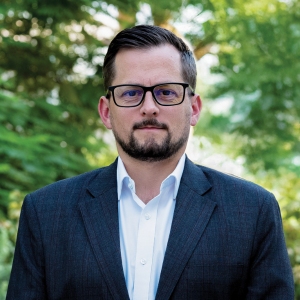
Tom Olliver
Director - rail, Qiddiya
Expertise
Design, Project ManagementLocation
Saudi ArabiaMy highlights
Leading the infrastructure assurance, planning and operational readiness of Qatar’s rail networks ahead of the FIFA World Cup Qatar 2022
The design of various metro systems in India, Qatar and Saudia Arabia
The Kárahnjúkar Hydroelectric Project in Iceland, which in 2007, was one of the largest engineering projects in Europe with 73km of tunnels
I would recommend a career in rail because…
There are many points I could touch on, but the highlight for me is being able to provide a lasting, sustainable legacy.
In rail, there are a diverse range of opportunities as you get to work across multiple specialisms – including civils, systems, operations and transport integration.
With complex projects, you’re always being challenged.
There is also an opportunity to travel. I’ve been lucky to travel all over the world with my work, which has been amazing!
In rail, the highlight for me is being able to provide a lasting, sustainable legacy.
What’s the most exciting part about being a rail engineer in the 21st century?
A hot topic around the world is that our cities are congested but continue to grow. There is a pressing need to address this, and rail systems are an obvious solution.
As cities will become increasingly overcrowded in the future, it’s going to be much harder to build new infrastructure.
There will be the need for more intense engineering work to build solutions underneath, next to, around and through pre-existing buildings and infrastructure.
200 years ago, the Stockton and Darlington Railway was steam powered, but it was cutting edge at the time. The engineers learnt as they built.
The difference today compared to 200 years ago, is that in our future we will have much more capable public transport with solutions such as faster trains, double decker trains and higher capacity systems.
We asked Tom…
A day in your life...
I’m office-based in Riyadh, Saudi Arabia’s capital, where I manage the client-side design team for my current metro design project.
I spend my days leading design reviews and interacting with all our internal stakeholders. As with many roles today, I spend a lot of time on Teams calls in meetings.
After work, I enjoy spending my evenings with my wife Anna (also a chartered civil engineer) and my 10-year-old son, Adrian.
What inspired you to work in civil engineering? And why did you specialise in rail?
My grandpa, Dennis Olliver, was a civil engineer and an ICE Fellow, which sparked my initial interest.
When I was growing up, there were several large-scale civil engineering projects in the UK.
Through school, I visited the Channel Tunnel during construction and the Thames Barrier. Both projects inspired me.
I started my career as a tunnel engineer, and then progressively moved onto more complex and interesting projects, which happened to be underground metro projects.
In readiness for the FIFA World Cup Qatar 2022, I worked on the infrastructure assurance for the Doha Metro.
As the construction phase drew to an end, my role transitioned to rail operations, crowd management and the customer experience side in preparation for the event.
This shows how broad the rail industry is!
What’s the most exciting project in rail at the moment?
The Mumbai–Ahmedabad high speed rail corridor in India.
It will span over 500km, use Shinkansen technology, reach top speeds of 320km/h and will be India’s first high-speed rail line.
Having worked in India previously, I think it will be transformative for communities there.
What’s the biggest thing the public misunderstands about railways and how they operate?
There is a lot of misunderstanding about rail system capacity.
People often think capacity can be increased by simply adding more trains, but it's far more complex.
Considerations include existing infrastructure, platform lengths, station sizes, depot sizes, the power supply, signalling, required resilience and reliability targets – and that’s just for starters!
It’s difficult as you can't just add, for example, double decker trains without first changing all the bridges and tunnels along a route.
Sometimes it's better to have lower capacity but at a much more resilient level.
What do you think is the key to a society-wide modal shift towards public transport, particularly rail?
Getting an end-to-end integrated public transport solution where the customer is placed at the centre of the design is key.
Not just station to station but also including their first to last mile.
If we don’t think about the customer and their requirements, we will never get a solution that works for all.
How does your role contribute to making the industry more diverse and inclusive?
In Saudi Arabia, I work with a diverse mix of colleagues and consultants each bringing insight from projects across the world.
I too bring experience from working on major projects across Europe, Asia and the Middle East.
In addition to this geographic diversity, I bring knowledge from different stages of rail development, from the feasibility stages through to detailed design, construction and then operations.
Diversity is important, not just from nationalities and cultures, but also industry experience.
We’re lucky to benefit from this here in the Middle East.
What role does digital technology play in your job?
Digital technology is crucial when coordinating with multiple stakeholders and design centres across the world.
We are in a vastly different age now where we work with people across continents. We need the right technology to ensure we can collaborate on projects in real time.
It's also critical to ensure the customer has the right technology to provide enhanced customer experiences, such as wayfinding and passenger information.
What motivated you to become professionally qualified?
It was a multitude of reasons, as it was a professional challenge to achieve chartership.
Being qualified is a way to gain professional credibility and recognition.
It offered career advancement through increased employer and stakeholder confidence.
What does being professionally qualified with the ICE mean for your career?
It’s opened doors throughout my career, helped me gain new experiences and allowed me to work in multiple countries.
It also helped improve my professional network and influence.
Most of all, it reinforces public trust in professional engineers.
How did the ICE and your employer support you to become professionally qualified?
At the time, I was on the graduate training scheme with my first employer. I will always be thankful for the mentorship I had there.
I was also living and working close to One Great George Street at the time, so was able to attend knowledge and networking events there.
I also attended a Tunnel Design & Construction course there as well.
How has being a member helped your career?
It has opened doors for me, providing networking opportunities and the opportunity to give back as a mentor, reviewer and committee member in ICE Qatar (previously) and now ICE Saudi.
How has achieving Fellowship changed your career?
Fellowship has provided enhanced recognition of my capabilities in the industry, as well as given me opportunities to speak to people I wouldn’t have otherwise.
Having those senior connections can really add gravitas to your discussions.
What’s the biggest or most complex thing you’ve made out of LEGO®?
I helped assemble the world’s largest Lego bridge with ICE Qatar during the bicentenary in 2018.
It was a 33 metre-long suspension bridge made from more than 260,000 Lego bricks.
At home, my son Adrian keeps me on my toes with his own building skills, although we haven’t quite made anything on as large a scale (yet)!
Disappointingly, Adrian is getting so good at Lego, he doesn’t need my help quite so often anymore.
Do you have any hobbies?
I’m a passionate photographer in my spare time.
I really enjoy combining my love of photography with my love of travel, challenging myself to really notice what would make a fun, interesting or beautiful picture.
Being based in the Middle East for the last 18 years has meant we have had the privilege to explore and travel to a variety of wonderful places.
We recently visited Machu Picchu as a family, but I am just as happy finding off the beaten track locations here in Saudi Arabia.
Tom's career path
I studied civil engineering with management at the University of Birmingham, before joining Mott MacDonald as a tunnel engineer.
I was at Mott MacDonald for over 10 years, working across the globe on a variety of projects in the UK, Iceland, India, and Abu Dhabi.
In the 23 years since I graduated, I have continued to work across the world on a variety of interesting projects. I'm now leading the planning for a new metro-grade rail system in Saudi Arabia.
During my career, I’ve valued great mentors who shared their experience and knowledge and helped get me chartered through their accredited training scheme with the ICE.
I became chartered with the ICE after being a graduate member for four years, and then successfully applied for Fellowship in 2019.