





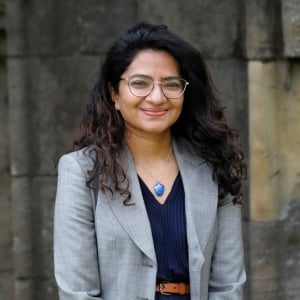
Svetlana Joao
Deputy project manager, TYPSA
Expertise
Design, Structural, Project ManagementLocation
LondonMy highlights
ICE President's Future Leader 2022-2023
Working on major projects such a HS2
I would recommend a career in rail because…
There are so many benefits to a career in rail!
First of all, you’ll never be bored. I have learnt so many different things already.
I began my career focusing on the technical aspects of infrastructure, working on the design and structural elements to ensure robust and efficient solutions.
Over time, I transitioned into a leadership role, where my focus expanded to collaborating with a range of clients and stakeholders.
You learn something new every day and knowing that your career has a lasting impact on society makes it so much more meaningful.
Public transport delivers countless benefits, but we must make it accessible to everyone.
What’s the most exciting part about being a rail engineer in the 21st century?
The most exciting part of being a rail engineer today is how we use technology.
Two hundred years ago, everything was done manually, but today we use digital tools to speed up our processes.
Technology helps me and my team collaborate on projects in real-time, and it means that we can quickly identify potential issues before they become bigger problems.
In 200 years, I suspect technology will be even more powerful. But we must be careful that we don’t rely on technology too much.
We mustn't lose ownership of projects, and we must continue to apply critical thinking to make sure our projects are still safe and of a high standard.
We asked Svetlana…
A day in your life...
Every day is different, but I always try to follow a routine to stay disciplined.
When I work from the office, I usually read a book during my morning commute, though some days I work from home.
I’m currently working with two site support teams to deliver different parts of HS2.
The first is led by TYPSA. We’re working on the detailed design of the C2/C3 (HS2) route, which is from London to Birmingham.
The second is part of the TYPSA and ARUP Joint Venture (TAJV), where I liaise with TYPSA and ARUP teams.
In both projects, my leadership role requires me to ensure that the project runs on time, stays within budget, and meets the required quality standards. This involves:
- working closely with the teams to assign tasks;
- monitoring progress;
- liaising with clients; and
- maintaining regular communication to ensure a smooth workflow.
After work, I often go for walks to keep myself active, attend events, or spend time with my loved ones.
What inspired you to work in civil/infrastructure engineering? And why did you specialise in rail?
I was inspired to become a civil engineer when I realised the contribution that I could make to society.
There are numerous ways in which civil engineers can positively impact communities.
I was born in Angola (Africa), and it’s a developing country.
Seeing the country's social issues ultimately inspired me to become a civil engineer. I wanted to be in a job that could help solve these issues.
In other words, I was inspired not by a specific project but by the lack of good infrastructure I experienced at a young age.
What’s the most exciting project in rail at the moment?
Crossrail, more popularly known as the Elizabeth line!
People seem to love travelling on it. It’s great to see that it’s received such a positive response.
What’s the biggest thing the public misunderstands about railways and how they operate?
I think the public often underestimates just how vital rail is to society.
It’s easy to focus on the negatives like delays, cancellations, or the length of a commute but what often goes unnoticed is the sheer scale of what rail enables every single day.
Rail connects people to jobs, education, healthcare, and loved ones.
It supports the economy by moving goods efficiently across the country, reduces road congestion, and plays a crucial role in cutting carbon emissions.
Without it, many of the things we take for granted would become significantly more difficult, if not impossible.
What do you think is the key to a society-wide modal shift towards public transport, particularly rail?
Changing public perception of transport starts with shifting people’s mindset.
Public transport delivers countless benefits, but to truly unlock its potential, we must make it accessible to everyone.
Accessibility isn’t just a nice-to-have; it’s essential.
The easier it is for people to use public transport, the more likely they are to choose it. And the more they use it, the more they’ll recognise its value.
How does your role contribute to making the industry more diverse and inclusive?
As a Black woman in the industry, I’m committed to creating an environment where everyone, regardless of their background, feels welcomed, valued and heard.
A big part of my day-to-day job is communicating with my team to create an environment where everyone feels that they are part of the project.
Apart from day-to-day work, when I visit schools as a STEM ambassador, I often speak about my background and the difficulties I have overcome to get to where I am. It’s my hope this will inspire students to join the industry.
What role does digital technology play in your job?
When it comes to leadership, technology has a huge impact.
We use advanced tracking technology to stay on top of a project’s progress, including all aspects of it, such as health & safety issues.
We also use BIM technology in the design phase of the project.
BIM allows us to identify and resolve any clashes in a model early on.
We can examine various models from different disciplines, including structural, architectural, geotechnical, and environmental.
BIM helps us to save time and costs compared to the traditional AutoCAD approach.
Why would you recommend a career in civil engineering?
I would recommend a career in civil engineering because of our significant impact on society.
Civil engineers build schools, hospitals, housing, roads, bridges, and so on.
We can transform society into a better place for everyone by solving the issues that society is dealing with.
Even more, we can tackle some of the UN Sustainable Development Goals (SDGs) through our industry.
We have a diversity of choices in civil engineering, such as structural engineering, environmental engineering, geotechnical engineering, and transportation engineering.
Which civil engineering project (past or present) do you wish you’d worked on?
I wish I could have worked on a past project that started in 1988 and was completed in 1993 - the Channel Tunnel.
It’s so incredible the complexity of the tunnel. It’s 50.45 km long and made of three separate tunnels running parallel to each other.
One train tunnel running south (UK to France), one train tunnel running north (France to the UK) and one service tunnel.
As a structural engineer, it's fascinating how the tunnel was detailed to overcome some large forces, such as the constant water pressure.
It's also a great project because it promotes a good connection between both countries.
What about being a civil engineer gets you out of bed each morning?
Each day as a civil engineer is a new challenge. I always need to keep my mind open to learn something new (which is impressive).
Name one civil engineering myth you’d like to bust.
The biggest myth is that civil engineering is just for a specific type of person. This is not true at all.
The construction industry is entirely diverse, with different opportunities.
For example, as a civil engineer, you could work in construction, design, project management, and so on.
I believe that each individual has different skills that could contribute, and this is the beauty of having diversity in the industry.
What motivated you to become professionally qualified?
When I first moved to London six years ago, one of the first steps I took was joining ICE as a graduate member — even though I wasn’t entirely sure what that would entail at the time!
Once I began working, it quickly became clear that pursuing professional qualification was something I genuinely wanted.
I found myself really enjoying the industry, and becoming professionally qualified felt like a natural and exciting next step in my career journey.
Any personal causes or hobbies?
Outside of work, I really value spending time with my family and friends.
I like getting involved in different committees and doing a bit of voluntary work when I can.
I enjoy going for walks, discovering new places, and travelling.
I’m also a big foodie—I love trying new restaurants and different cuisines—and I always make time for a good book.
Svetlana's career path
I studied my bachelor's in Civil Engineering and masters in Structural Engineering in Lisbon, Portugal.
I did an internship at the National Laboratory of Civil Engineers, where I worked on a project to implement asset management through building information modelling (BIM) in the laboratory.
After that, I moved to London and joined TYPSA, where I contributed to the detailed design of the West Ruislip Station (for HS2).
Today, I'm working as a deputy project manager at TYPSA, where I combine my technical background with leadership responsibilities to help deliver the project successfully.
Major projects
- HS2 West Ruislip Portal



Related Content

- Type
- ICE Community blog
7 lessons from my engineering career that keep me going when I want to give up
To mark International Women in Engineering Day (INWED), Svetlana Joao shares the insights and experiences that have helped her progress in her career, including becoming chartered and being a past President's Future Leader.

- Type
- Explainer
What is BIM? Understanding the foundations
Building information modelling (BIM) has become one of the most important developments in the digital transformation of the built environment.

- Type
- News
Nominations open for ICE president
Candidates who meet the requirements are invited to stand to represent the institution as a future president of the ICE.