Are the winds of change finally blowing for clean power?
Date
26 February 2026
Hailed as a great success, the UK's seventh Contracts for Difference auction could be industry changing, writes Tim Chapman.
The seventh auction round secured 8.4GW of new offshore wind capacity. Image credit: Ann in the uk/Shutterstock
Electricity in the UK is relatively expensive, for consumers and industry alike.
Both are painful politically. The government has pledged to lower household energy costs by up to £300 per year by 2030.
This is likely to be an issue in the next election. Our political consensus on thwarting climate change in the UK has been eroded, with some parties now opposed to green measures.
I’ve picked out three great achievements, three surprises, and three potentially industry-changing elements from the results.
What are Contracts for Difference?
The Contracts for Difference (CfD) scheme is the main way the UK encourages investment in renewable energy projects.
Each year, the government holds auctions in which renewable developers bid for contracts to support their projects. These auctions are called allocation rounds.
If successful, the developer signs a contract with an arms-length body, the Low Carbon Contracts Company (LCCC). The contract guarantees a price for the electricity they generate, called the ‘strike price’.
The contracts cover a period recently increased to 20 years, during which the market price of electricity, or ‘wholesale price’, will fluctuate. This is often influenced by gas prices, which frequently set the marginal price (the price for the most expensive energy needed to meet demand), but may do less frequently in the future.
If the wholesale price goes above the strike price, the developer pays the extra money back. This helps shield customers from high market prices.
If the wholesale price drops below the strike price, the LCCC pays the shortfall to generators. This guarantees revenue for developers, reducing risk and encouraging investment.
3 great achievements
A record result for offshore wind capacity
AR7 secured about 8.4GW of new capacity – a breakthrough in scale and enough to power 12 million homes (when it is windy, none when it isn’t).
This accomplishes about a quarter of the UK’s 2030 offshore wind target in one go – which it needed to do.
After previous failures – including 2023’s auction failing to attract any offshore wind bids at all – AR7 couldn’t afford to fall short.
Investment in UK industry
AR7 will unlock about £22 billion of private capital and support some 7,000 skilled jobs in the UK.
It’s important that this surge in investment, paid for by UK bill and taxpayers, will deliver industrial benefits for the country.
Good results for emerging technology
The achievement I find most exciting is that AR7 opened the door to floating offshore renewables – two relatively small projects at about 100MW each – which will enable deployment off the UK coast in ever deeper waters.
These projects will drive innovation and should lead to a whole new industry, potentially with the UK as its global epicentre.
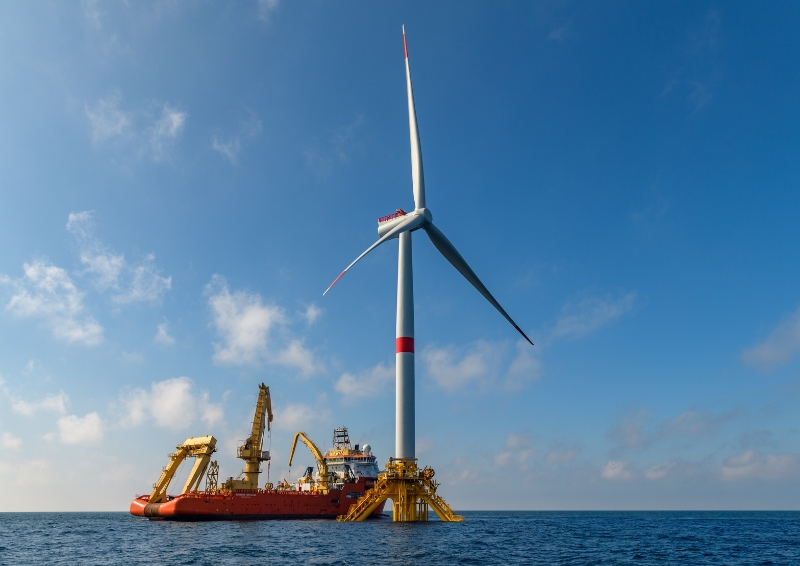
A floating offshore wind turbine being installed for the Provence Grand Large project. Image credit: Shutterstock
3 surprises
Some elements were controversial
Perhaps less surprising to some, but a shock to others: the strike price at about £90 per megawatt-hour (MWh) in 2024 prices for fixed offshore wind was significantly higher than in previous auctions. Although, this is still reportedly competitive with costs for new gas and nuclear.
Positively, this does much to revitalise the industry from previous rounds that were less economical and therefore less attractive for suppliers – such as AR5 in 2023.
This price has proved contentious, however, as some argue it may feed directly into consumer and industry bills.
The extension from 15- to 20-year contracts was also contentious, as it may increase total, long-term costs to consumers.
Timelines are tight
Suppliers have voiced concern about the ambitious timelines set for AR7 – not least because of the potential for grid connection delays.
New projects depend on grid connections for successful operation to benefit the UK. But ongoing reform to the grid connection process could mean that project connection dates change.
This, supply chain vulnerabilities, and more all pose risks to timely delivery of the clean power to homes and factories.
Newer technologies are expensive
The premium for floating offshore is high – clearing at £216 per MWh in 2024 prices – due to its very early stage of deployment.
It’s hoped that these early demonstration projects will mitigate risks and reduce costs. This sort of prototyping to innovate is rare in UK infrastructure circles and is to be applauded.
3 potentially industry-changing elements
Contracts lock consumers into longer-term payments
Extending CfD contracts to 20 years allows more competitive financing and therefore lower bid prices.
This reduces costs for UK consumers in the short term. But it exposes them to long-term costs that might not match emerging industry trends.
The change effectively ‘brings forward’ some of the expected long-term savings from clean energy to speed up the transition. Time will tell if this was the right move.
The price increase was a needed reset
For AR7, the government significantly increased the upper limit for strike prices (the ‘administrative strike price’).
While contentious, this enabled a successful auction round.
It showed the process has restabilised after the price cap problems in AR5 (no bidders) and AR6 (not enough winners).
The risk is that it was an over-correction. Like the extended contracts, it could lead to consumers overpaying for electricity.
This auction had to strike a delicate balance. Again, time will tell if it managed.
A new technology enters the mainstream
Floating offshore wind has now entered mainstream procurement, albeit not yet at ‘industry scale’.
This could unlock large parts of the UK’s territorial waters – such as the very windy Celtic Sea, Atlantic Ocean, and waters around Northern Scotland – that are too deep for fixed-bottom offshore wind.
The potential benefits are huge: more total wind power, more consistent generation, and investment in coastal communities across the country.
The UK simply needs to build on the momentum.
*The ICE welcomes guests to share their views about infrastructure policy issues on the Infrastructure Blog. These views are the views of the individual.
If you're interested in writing for the Infrastructure Blog, please email [email protected]. The ICE reserves the right not to publish articles that have been submitted.
Tim Chapman, partner and director at Boston Consulting Group