With wind an endless – yet intermittent – resource, is this clean energy the key to reaching net zero carbon emissions? And what are the advantages and disadvantages?
As wind blows it generates kinetic energy, which is energy from movement.
This turns the blades on a turbine, which then causes a shaft (drive shaft) within the system to rotate (view diagram below). This shaft is connected to a gearbox, which then turns a faster second shaft (high-speed shaft).
The second shaft links to a generator, which contains magnets that spin around coils of copper wire at great velocity. This is what generates electricity, which is then transferred to the grid to be used in homes, businesses, etc.
The larger the blades and higher the wind speed, the more electricity the turbine can generate.
A diagram of a wind turbine's interior mechanism. Image credit: Shutterstock
Best wind speeds for power generation
The total amount of energy generated doesn’t just depend on speed, but how long and how consistently the wind blows.
According to National Grid, efficiency is maximised at around 18mph (29km/h) and reaches its maximum at 27mph (43km/h).
Generally, the operating range of a wind turbine is between 7-56mph (11-90km/h).
Onshore vs offshore wind
Turbines are usually placed in groups, known as wind farms.
Onshore wind farms are on land – typically, on large, open fields.
The offshore variety is out at sea, where conditions are normally windier and there are less or no structures that can obstruct the wind.
Within offshore there are subcategories, with most turbines being built into the seabed using foundation towers. Floating offshore is an emerging category, with floating platforms that are anchored to the ground underwater.
Pros and cons
Pros:
Generally:
Uses a completely renewable resource
Generating wind power doesn’t produce any carbon emissions
Building and operating wind farms emits significantly less carbon emissions than fossil fuelled energy sources. They have similar lifecycle emissions as other forms of renewable energy, such as hydropower
Once installed, wind energy is cheap to operate. However, construction costs are now starting to rise with inflation
Can reduce electricity bills (Most forms of energy generation receive subsidies [i.e. through Contracts for Difference]. This stabilises consumer electricity bills until the subsidy period ends and the cost reduces to the wholesale market electricity price)
Onshore:
The sites the turbines are on can still be used for other purposes, such as farming
Quick to install and relatively easy to maintain (installation can be done in a matter of months)
Cheaper than offshore
Offshore:
More efficient due to stronger winds out at sea (fewer turbines required for same amount of energy as onshore) and the ability to build larger turbines
Less environmental impact and noise pollution due to distance from local populations
Available space for more wind farms
Cons
There are disadvantages to building wind farms, but as countries push to boost their use of renewable energy, a lot of work is being done to mitigate these.
Intermittency
By far, the most prevalent one is that this power is intermittent – the wind doesn’t always blow.
When this happens, back-up power supplies are needed to meet electricity demand, which today are typically from carbon-intensive fossil fuels.
Conveniently, wind strengths tend to be higher in the winter months, when need for electricity also increases (for heating, or for when the sun goes down at 4PM).
But for times when the supply simply cannot meet the demand, there are two key alternatives:
Using grid-scale batteries to store excess power when it’s very windy and drawing from them when needed (this is an emerging technology, with its own set of pros and cons). There are also other forms of energy storage such as pumped storage plants
Even then, having an energy mix that consists of several sources (solar, tidal, nuclear, etc) is essential to ensure countries always have more than enough energy (known as redundancy).
Environmental impact: emissions
Manufacturing and installing wind farms have their own emission footprints.
A historic review showed that the average farm produced 20-25 times more energy once it began operating than what was used to build and install its turbines.
Other concerns are around how wind farms affect biodiversity in the area, particularly birds and marine wildlife.
Wind farm developers conduct thorough environmental impact assessments, and ecosystems are closely monitored to determine how specific risks in those habitats can be addressed.
There’s evidence that wind power would still be a better alternative.
For instance, “emissions from fossil fuel power plants kill over 30 times more birds than wind farms, per produced GWh”, according to the European Commission.
The commission adds that “wind turbines are responsible for less than 0.1% of human-related bird deaths – much less than traditional energy plants and skyscrapers”.
Other commonly mentioned impacts are noise pollution and visual impact.
Wind farms are usually far away from inhabited areas, but even if you got as close as 300-400m, the sound would be as loud as the fridge in your kitchen, according to the European Commission.
You’d be more disturbed by noise and air pollution from living near road traffic.
Lastly, the visual impact is subjective.
Limited shelf life
Wind turbines have an average lifespan of 25 years although with effective maintenance and monitoring, more modern turbines can operate safely for 30 years.
Every wind farm in the UK is required to have its own decommissiong plan. This presumes that the farm will be dismantled at the end of its projected life.
However, there is some concern that this is not the best environmental or economic solution and work is ongoing to develop best practice.
The aim is to avoid decommissioning them as much as possible, while ensuring they are safe to operate.
Even then, 85% of wind turbine materials can be recycled. For example, some have been turned into bike shelters.
Global wind energy
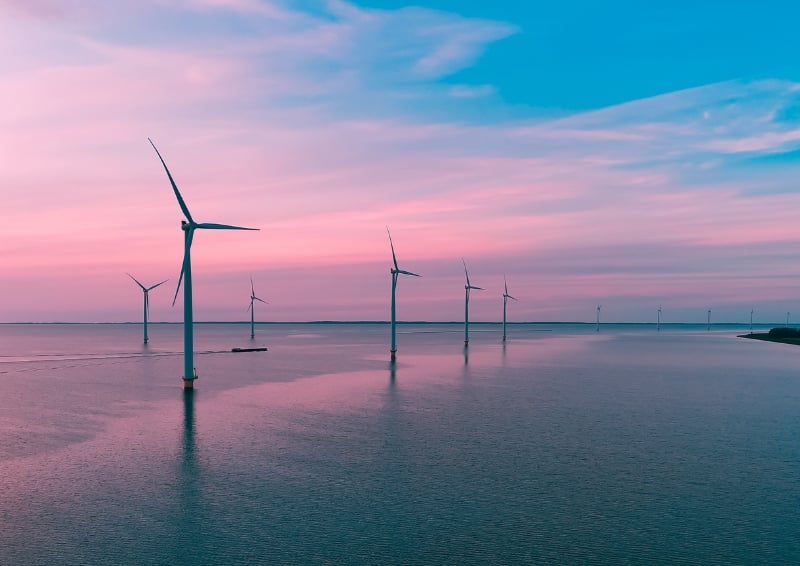
A wind farm off the coast of the Netherlands. Image credit: Shutterstock
As of 2024, there was 1,131GW of installed wind power generation capacity around the world – enough to power around 679 million homes.
Globally, wind energy prices have been reducing. Between 2010 and 2024, the cost of electricity from onshore and offshore fell 70% and 62%, respectively.
However, costs have now stabilised and instead are rising with inflation.
The story in the UK
The first UK offshore wind farm was built in 2000, off the coast of Northumberland in north-east England.
When completed, Dogger Bank, also in the North East, will be the world’s largest offshore wind farm, capable of generating 3.6GW and powering 6 million homes every year.
Ingrid Valceschini, associate director at Buro Happold, ICE Fellow and professional reviewer, reflects on how technicians contribute to successful project delivery and why the profession must continue to evolve.