





With a stronger focus on people, the UK’s new transport strategy is off to a good start, writes John Pelton MBE.
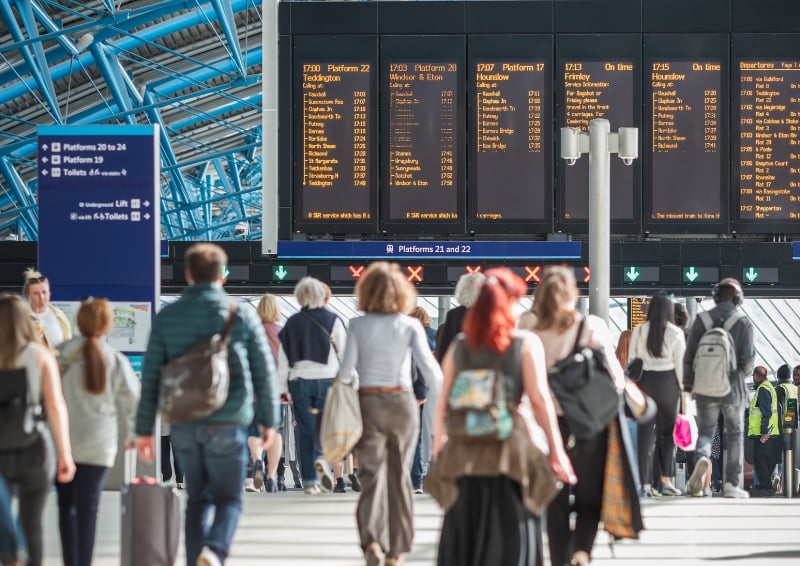
As I travelled into work on 2 April, the UK Department for Transport announced its new integrated transport strategy for England, Better Connected.
The ICE has long called for this strategy, so what better way to while away a commute than to peruse it, fresh off the press?
I then decided to cross-check it with the ICE’s thinking on the matter, which, crucially, called for a single strategic vision for transport in the country.
This took quite a while, as the Wi-Fi quality on the train was, at best, intermittent (improving transit communications would go a long way to improving the passenger experience, but the strategy was silent on that...).
Here’s how I felt the strategy measured up.
Transport systems that can cope with uncertainty
Most transport infrastructure was built decades ago, based on weather conditions that looked very different from those we see today.
Experts are gathering in Manchester this September to discuss how we can prepare our vital transport networks to cope with new extremes as structures continue to age.
Spaces at the Resilient Transport conference are limited and filling up fast.
People, place and partnership
I was immediately reassured by its guiding principles: ‘people, place and partnership’.
People
People have so often been an afterthought in our transport system thinking, so this was a good start.
The strategy covers many of the issues that have often rankled with transport users.
Information was a key point.
My local rail station, for example, has only recently started being served by any bus routes and the information available on connections has been pretty much non-existent.
In contrast, I recall Transport for London (TfL)’s foresight in releasing travel data that resulted in an array of helpful apps and information to plan journeys across the capital.
Place
The place aspect raised some concerns. There are some worthy aspirations, but past experience suggests that there’s a way to go yet.
Examples abound of not just poorly connected but completely disconnected transport.
Rail stations with inadequate parking, cycle lanes that trigger gridlock in medieval cities, taxi capacity consumed by school runs, and more.
The concern isn’t that the strategy doesn’t recognise this.
It’s that planning authorities, having been stripped of capability over decades, are already struggling to provide effective, integrated town and city planning.
Can we expect them to cope with the additional pressures that Better Connected may place on them?
Partnership
Partnerships, surely a no brainer?
When South West Trains worked with Network Rail to form the Wessex Alliance, the service improved.
If they’d worked with the towns along the route to develop interconnected bus services and taxi support at stations, it would’ve been even better.
So, we can do this, but it seems we find it hard to sustain improvements.
The Wessex Alliance broke down as the franchise was reset, and the concept then collapsed under the unrealistic expectations placed on the new franchisee.
Partnership is fundamentally based on a mutual understanding of shared risks and aligning the right partner with the right risk.
Past precedents of risk-dumping on the private sector or on the lowest level of authority without providing enough resources will need to change.
The new strategy is silent on this.
Integrated planning: will the strategy address car dependency?
Local transport systems, and the economies of which they’re an integral part, don’t exist in isolation. Regional and national interconnectivity is essential for places to thrive.
As my journey progressed, for instance, I acknowledged my good fortune in being able to complete most of my commute by train, bus/tube and on foot.
Although the 1.7 miles between my home and the station are best done by car, especially early in the morning and in bad weather, I can walk. The car is a choice.
However, as we still use cars for 76% of all journeys (by distance), it seems I’m atypical in having a choice between different ways of travelling.
We have a strategic challenge: even if travel by bus and train were to double (which would easily overload both systems currently) we'd still be left with over half of all journeys being made by car.
Reshaping lifestyles
We have a legacy of 50 years of car-based town planning to address.
Put simply: the car has shaped the places in which we live.
If this is to change, then local authorities will need a re-think.
A couple of years back I attended a local consultation for a new supermarket. It was wholly based on the premise of shoppers travelling by car, adding more traffic to already busy local roads.
Addressing this will require local authorities to enable communities in cities, towns and villages to reshape not just their transport but their whole way of life.
The strategy proposes reshaping local authorities and devolving central decision-making and resources to achieve this. These are great ideas, provided that the new authorities have the capability, including planning and resources.
Implementing partnerships in this context will require a lot of new thinking and revitalised local community governance.
Paying for transport when budgets are running on empty
As my journey neared its end and we approached London, we were fed updates and information on the tube, buses and overground rail services.
This meant that by the time I walked out the ticket barrier, I’d been able to plan my route to my final destination. Ironically, I chose to walk and enjoy the spring sunshine!
But it seemed to me that this was the nub of the issue: being able to make informed choices about my journey.
This is woven into the Better Connected strategy, which is encouraging, with one critical exception: price.
London’s route planning apps enable choice based on a variety of factors including journey time, route preference, weather conditions and comparative cost.
This seems like a missed opportunity in Better Connected.
Particularly during straightened times, when people need to factor in the comparative cost. Given the dominance of car travel, this places the spotlight back on the roads.
The role of road pricing
In 2013, the ICE advocated for road pricing in its State of the Nation transport report.
This model would see a form of ‘pay as you go’ charging for road users instead of fuel and vehicle excise duty (VED).
It not only provides an equitable way of charging in proportion to use and road type but also allows the person travelling to make a proper comparison between alternatives.
A flexible road pricing strategy could also support traffic management and help to avoid HM Treasury’s fuel duty challenge as electric vehicle use increases.
Wanted: detail on sustainability
As I completed my journey, I crossed Parliament Square and remembered the Extinction Rebellion protests in 2019, which brought this part of London to a halt.
As a nation, we are, broadly, committed to sustainability and we’re consistently reminded of the effects of global warming.
The current Middle East war also exposes our vulnerability to energy price shocks and the resulting economic impacts.
Surface transport is the single biggest contributor to UK emissions and is heavily dependent on oil products.
It seems odd, if not contradictory, that I could find barely a page on sustainability buried in the section on creating healthier communities.
Again, some useful measures, but hardly the strategic plan to make national impact.
We’re missing that ‘golden thread’
I arrived at work on time. Largely, because my train was bang on time.
A good start to the day, just like Better Connected is also a good start to making travel easier, more affordable and safer across the UK.
But there needs to be more strategic thinking, and some seriously joined-up planning if it’s to be an effective response to the challenges we face.
What we need is a ‘golden thread’ of desired outcomes across transport modes and levels of government that can enable a coherent and sustainable transport system.
That requires the strategic vision that the ICE has been calling for.
*The ICE welcomes guests to share their views about infrastructure policy issues on the Infrastructure Blog. These views are the views of the individual.
If you're interested in writing for the Infrastructure Blog, please email [email protected]. The ICE reserves the right not to publish articles that have been submitted.

You may also be interested in

- Type
- Infrastructure blog
Rewiring the State: what does England’s devolution mean for infrastructure?
These reforms would change where decisions are made, who holds influence, and how infrastructure and other investment priorities are determined.

- Type
- Infrastructure blog
CCC report shows it’s time to supercharge the UK’s electrification ambitions
The UK must speed up the electrification of transport, homes, and industry to reap the benefits of reducing emissions.

- Type
- Infrastructure blog
What Britain’s longest new railway in a century can teach us about reusing infrastructure
The Scottish Borders Railway shows that you can meet user needs without having to build new every time – and lower carbon emissions in the process.