





ICE Knowledge Hub
Access the very latest and best CPD content to help you grow your knowledge and skills.
Sign in now

Making the UK as inclusive as possible is important to the wellbeing of the population. Helen Littler explores what adaptions we can make to our transport network.

Originally published 18 July 2023
Creating and maintaining an accessible public realm is crucial for ensuring that disabled people are not excluded from playing a full role in society.
There are specific things we can do as engineers to achieve this.
But it isn’t always straightforward. We face issues such as retrofitting older infrastructure to modern standards, and deciding which design to use to meet the needs of differing disabilities.
The Equality Act enshrines the rights of disabled people as well as other protected characteristics.
It defines somebody as having a disability if they have a physical or mental impairment which has a substantial and long-term adverse effect on their ability to carry out normal day-to-day activities.
Nearly 18% of the UK population have a disability and many people will develop one later in life (for example, through illness or injury).
The adjustments made for those with disabilities also benefit others with short-term conditions, such as pregnancy, or those with small children.
"The most commonly used symbol for disability is the wheelchair, despite fewer than a 10th of all disabled people using one," explains Jim Morey, director at Le Chat Noir Ltd.
"But even wheelchair users are not one homogenous group. The needs of an otherwise healthy lower-limb amputee will be very different to somebody who's in the latter stages of a degenerative disease.
"Similarly, the experiences of a person who’s been totally blind or deaf since birth will be different to somebody who has gradually lost their sight or hearing in later life."
The Equality Act 2010, puts a legal requirement on public bodies to address or minimise the disadvantages faced by individuals because of their protected characteristics.
They must implement measures to accommodate the unique requirements of individuals belonging to protected groups, which may differ from those of the general population.
In 2021, the Department for Transport released Inclusive Mobility: A Guide to Best Practice on Access to Pedestrian and Transport Infrastructure.
It ties in guidance from elsewhere, including relevant British Standards, Building Regulations and LTN 1/20 Cycle Infrastructure Design.
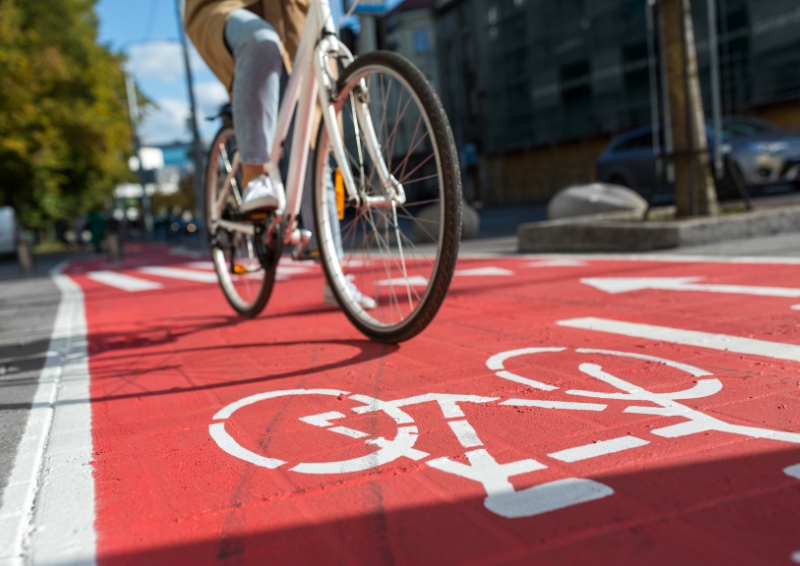
The latter is important as a cycle can often be a form of transport for those with disabilities.
There are design considerations which need to be made for the differing types of disabilities.
Intersectionality describes people who not only have single or, often, multiple impairments, but may also belong to another demographic that’s disadvantaged as a result of their ethnicity, sex or gender, age, pregnancy or parenthood, or other status.
This can compound the barriers faced when attempting to access goods and services.
Jim Morey, director at Le Chat Noir Ltd
Mobility impairments includes people who use wheelchairs and those who can walk but only with difficulty.
Those with walking difficulties outnumber wheelchair users by about 10:1.
When designing for those with mobility impairments, some key transport considerations are:
More than two million people in the UK have visual impairments, of which around 20% are registered blind or visually impaired.
Use of tactile information assists many to navigate the streets, but use of colour is also important to provide contrast between different items for those with impaired vision.
A good example of a simple adjustment is the provision of flush kerbs at crossing points.
Flush kerbs ensure those in a wheelchair, using a mobility aid, or with a walking difficulty can cross a side road without needing to bump their wheelchair up a kerb, lift their mobility aid, or risk tripping.
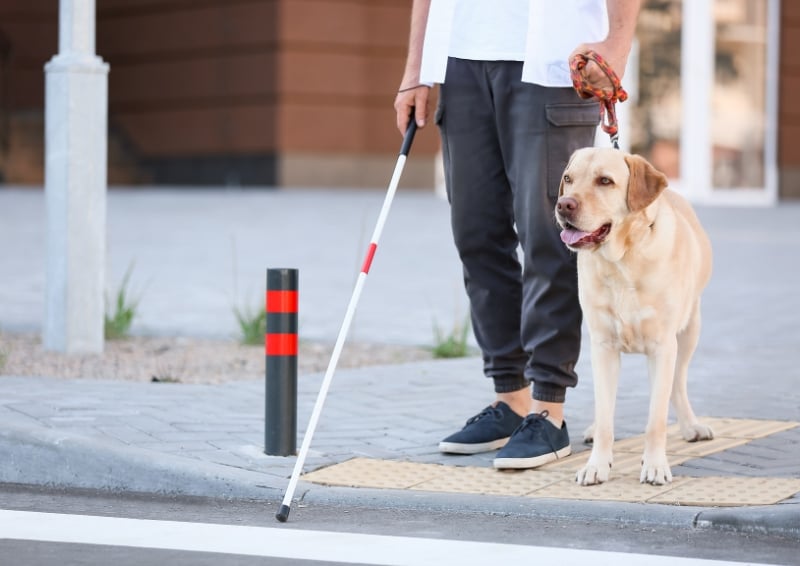
Flush kerbs also provide guidance to visually impaired users that they’re at a crossing point.
Guide dogs are trained to stop at flush kerbs so their owner can check for traffic before crossing.
Tactile paving at crossings is formed of raised bumps. This enables users to detect they are at a crossing through feel and sight using contrasting colours, so they orientate themselves.
Other types of tactile paving are used elsewhere on the transport network to guide visually impaired people and highlight hazards by different types of raised ribs and bumps.
Where it is omitted, it can cause visually impaired people to encounter dangerous situations, such as train platforms.
However tactile paving can cause issues for those using mobility aids, as it can make it difficult to push a rollator or wheelchair across tactile paving.
It can also cause discomfort for those with arthritis.
Therefore, it must be used carefully to convey information without excess use.
Over 18 million adults in the UK have some form of hearing impairment.
It's therefore important that key information is conveyed visually as well as audibly.
When navigating the highway network, someone with a hearing impairment might not hear approaching vehicles or cyclists.
The research undertaken as part of the Inclusive Mobility guidance considered the accessibility needs of individuals with mental health conditions, dementia, age-related impairments, and non-visible impairments.
It identified barriers in the pedestrian environment, such as obstacles, uneven surfaces, road crossings, slopes, and ramps.
It found that these barriers significantly impact individuals with mental health conditions, deterring them from travelling.
Simplifying pedestrian environments, incorporating distinct features, providing clear information, and promoting navigation and confidence in travel would benefit these individuals.
Within the public realm, we are often retrofitting to existing infrastructure which pre-dates guidance on accessibility.
Often space is constrained geometrically, restricting our ability to provide enough width for those with disability to move and turn through the spaces.
Gradients are another challenge, with infrastructure tying into existing topography creating steep gradients not in accordance with the guidance.
Crossing points where the footway ramps down to carriageway level can cause issues.
If the gradient is too steep, a wheelchair or cycle users might struggle to hold themselves stationary waiting for a gap in traffic.
There are also conflicting requirements when redeveloping our infrastructure to prioritise walking, wheeling and cycling.
Changes to the Highway Code in 2022 required that vehicle drivers should give way to pedestrians crossing or waiting to cross a road.
Many authorities are designing side road crossings to give priority to those walking or wheeling through continuous footways.
While this asserts the priority of those walking and wheeling, it removes much of the tactile information those with visual impairment rely on.
This can make the junction invisible to them as they don’t realise they are crossing a road.
There are means to ensure design work is inclusive for all and recommendations have been applied appropriately.
These can be used in all types of engineering projects, not just transport schemes.
Equality Impact Assessments (EQiA) are used to appraise the impact of a proposed scheme on protected characteristics including those with disabilities.
Will Haynes, infrastructure director at Sustrans, a charity working to make it easier for people to walk and cycle, says we need to start from a place of understanding the needs of individuals.
"In many cases, these people will have very different lived experiences to me, so if I am going to design infrastructure that works for them, basing my design on my own experiences is flawed,” he says.
He shares some recommendations:
We need to build teams that bring together as wide a range of lived experiences as possible.
We need to ensure that we’re involving the people for whom we are designing the infrastructure.
It’s vital that we do not forget groups of people who we may not have included in the past, and work to amplify those seldom-heard voices where necessary.
We need to broaden our own experience and encourage our teams to do so. While we may never be able to fully understand other people’s lived realities, we may be able to gain a small insight into other experiences.

ICE President David Porter explains why being informed about flood risk is so important for the public and civil and infrastructure engineers.

The electrification of the Core Valley Lines impressed the judges at the 2026 British Construction and Infrastructure Awards.

Good decisions made at speed can lead the industry down unintended paths, writes Steven Yule, ICE country representative for the UAE.
