





Engineers need to cut both types of emissions from their projects to move towards net zero targets.
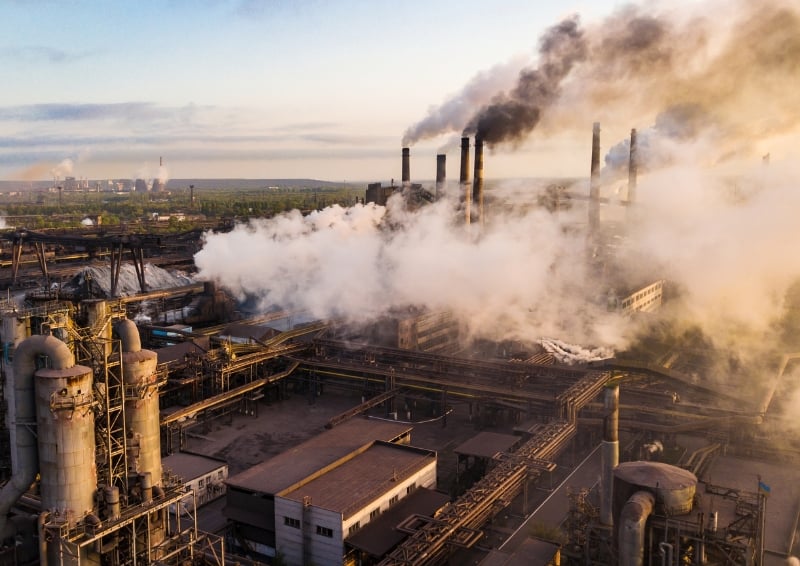
Infrastructure and buildings are one of the most significant contributors to climate change, accounting for about 34% of global CO2 emissions.
The way we design, build, and operate assets today – be it roads, water pipes, data centres and more – will shape emissions for decades.
Understanding where emissions come from and how to address them is essential if projects are to meet the expectations of clients, regulators, and society.
Embodied vs operational carbon
The terms embodied and operational carbon are commonly used to describe emissions throughout the lifecycle of an asset – from conception and design to maintenance and decommissioning.
Yet, they are often misunderstood and even confused with project phases.
The distinction has value, but it’s not always clear-cut.
To help explain the overlap, we will refer to the following standards:
- PAS 2080:2023: the UK’s leading standard on managing whole-life carbon in infrastructure and the built environment
- BS EN 17472: the European standard for sustainability of construction works (civil engineering works)
Embodied carbon
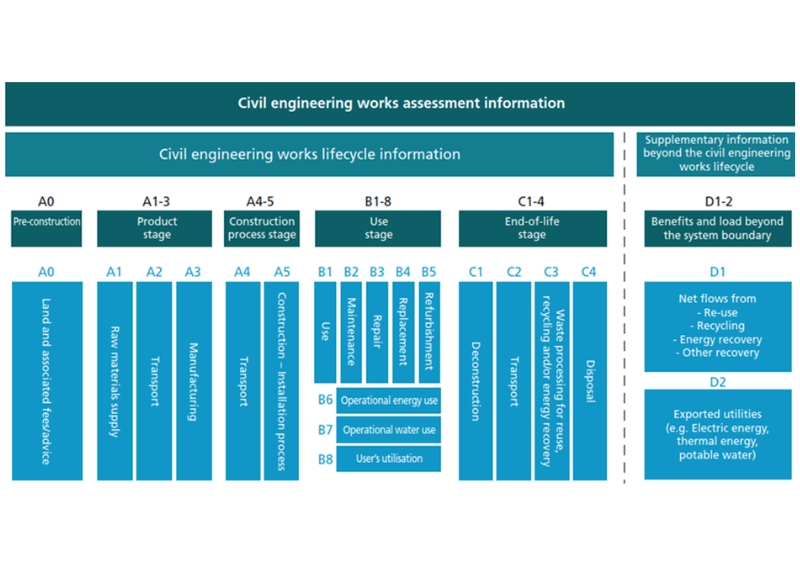
Embodied carbon refers to the greenhouse gas emissions released during the sourcing, manufacturing, transportation, and assembly of materials used in a project.
It encompasses the entire chain of processes that bring materials into use.
For instance, from extracting raw materials such as sand or iron ore (module A1, as per BS EN 17472, view the diagram above) to transporting them to a manufacturer (A2) and ultimately transforming them into finished products, such as concrete blocks or steel beams (A3).
These emissions are typically highest during the early construction phase but can also occur later. For example, during maintenance or component replacement (B2-B5) or during the end-of-life stage (C1-C4).
Think of it as the carbon ‘embedded’ in a material.
Its other names
Embodied carbon is sometimes referred to by other names, depending on the context.
Terms such as capital carbon or upfront carbon are often used interchangeably, particularly in the context of infrastructure or building design.
These terms highlight different aspects of the same idea, whether the focus is on the initial investment of carbon at the point of construction (capital) or the emissions released before the asset is in use (upfront).
Operational carbon
Operational carbon refers to the greenhouse gas emissions associated with the functioning of an asset throughout its life.
PAS 2080 defines it as “greenhouse gas emissions and removals related to the operation of an asset, network and/or system required to enable it to operate and deliver its service”.
Through the lens of a project, and for PAS 2080 reporting, operational carbon is typically allocated to the use phase (B1 to B8).
More specifically, to B6-B8, covering the energy required to operate, heat, cool, or light an asset once it’s in service.
Where overlap exists
Operational emissions can also be observed earlier, for example, during construction or manufacturing.
These should be reported at the company (scopes 1, 2, 3) and project level (BS EN 17472) to ensure alignment and drive reductions consistently.
For instance, diesel used to run plant or temporary site generators is operational in nature to a contractor as an organisation, and they would log it as a scope 1 emission.
But for the project, these emissions would remain in the construction stage (A5).
The key distinction is that, while operational-like emissions may appear in modules such as A5, for PAS 2080 compliance, operational carbon for a project is reported only within B6–B8.
Other modules still capture these activities, and the dual reporting approach – company and project – helps align corporate inventories with project-level assessments.
Reducing emissions through the whole life cycle
From a project perspective, it’s essential to consider the total embodied and operational impact across the optioneering, design, and construction stages.
This requires clarity on where emissions best sit in the life cycle, how they respond to design or programme changes, and how they influence whole-life outcomes.
Frameworks such as PAS 2080 and BS EN 17472 provide a modular structure that ensures all emissions are captured and managed consistently, supporting more effective whole-life carbon reduction.
In our next article, we will take a look at how to reduce both types of carbon emissions on a project.
In the meantime:
- Learn more about the PAS 2080:2023 standard
- Find out who's responsible for decarbonising different parts of a project
Permission to reproduce extracts from British Standards is granted by BSI.
British Standards can be obtained in PDF or hard copy formats from BSI Knowledge: https://knowledge.bsigroup.com or by contacting BSI Customer Services for hardcopies only:
- Tel: +44 (0)20 8996 9001
- Email: [email protected].


Sustainable Development Goals:
You may also be interested in

- Type
- Awards and competitions
Recycled materials offer sustainable future for concrete in royal patron award-winning research
The annual award celebrates outstanding ideas, research and best practice.

- Type
- News
What do the 2026 party conferences mean for infrastructure?
The ICE breaks down the headline announcements from five of the major UK parties.

- Type
- Explainer
What you need to know about PAS 4010: improving productivity in infrastructure development and delivery
A new standard, which will guide the sector in improving productivity, is set to launch in 2026.