

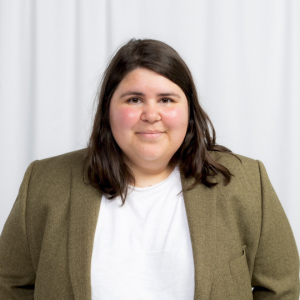
Emma Cox-Galley
Head of programme delivery, Mining Remediation Authority
Expertise
Project Management, Water, Environmental ManagementLocation
North WestMy highlights
Being one of the first passengers to travel across the Ordsall Chord railway bridge, a project I worked on for several years
Completing a six-month secondment in Malmö, Sweden, focusing on modular affordable housing
Leading the development of a strategic business case for the programme I now head, which I took through government approvals
A day in my life
No two days are the same in my role.
I lead a national programme that addresses mine water pollution and reduces environmental risks to rivers, streams and groundwater. My role involves setting strategy, working with experts and making sure we deliver solutions that protect people and the environment.
I spend a lot of time coaching and mentoring my team who come from a wide range of technical backgrounds. I also regularly engage with senior stakeholders and innovative suppliers, especially because our programme includes new and emerging technologies.
Many days involve visiting one of our mine water treatment sites. These sites often use nature-based solutions to clean and filter mine water before it is safely released back into the environment.
I believe inclusion is closely linked to safety. When people feel comfortable being themselves, they are more likely to speak up about concerns, whether that relates to unsafe practices or inappropriate behaviour.
What inspired you to become a civil engineer?
I first became interested through an engineering education scheme at school, encouraged by my maths teacher. As part of the programme, I worked on a project to design a novelty boat lift for a canal extension.
That experience showed me how I could use my strengths in maths and science to make a real, positive difference to people’s lives.
We asked Emma…
I would recommend a career in civil or infrastructure engineering because...
I would recommend a career in civil or infrastructure engineering because of the variety it offers.
There are so many different paths you can take and the opportunities are almost endless.
Complete this phrase: I'm a civil or infrastructure engineer but I'm also...
A people leader and coach.
A big part of my role is helping others grow in confidence and capability and creating an environment where everyone can thrive.
Name one civil or infrastructure engineering myth you'd like to bust.
A common myth is that engineers spend all their time sitting behind desks doing calculations.
In reality it’s a varied career. You can be out onsite, working with communities, solving problems and leading teams.
How does your role contribute to addressing climate change?
My role helps address climate change by protecting water resources. As extreme weather becomes more common, the UK is likely to face greater pressure on water supplies.
The programme I lead not only prevents contamination of drinking water but also explores how mine water can be reused to improve resilience in times of drought.
How does your role contribute to making the industry more diverse and inclusive?
I play an active role in creating a diverse and inclusive workplace. As a programme leader, I am responsible for building teams with a wide range of perspectives and ensuring everyone feels included.
I believe inclusion is closely linked to safety. When people feel comfortable being themselves, they are more likely to speak up about concerns, whether that relates to unsafe practices or inappropriate behaviour.
I’m also involved in initiatives to support underrepresented groups, including mentoring and professional qualification support. I have supported LGBTQ+ inclusion through employee networks and previously led a Pride network within the construction industry.
What role does digital technology play in your job?
My programme generates a huge amount of data, so digital technology plays an important role. It helps us analyse and understand complex information, which supports better decision-making and more effective solutions.
What motivated you to become professionally qualified?
I was motivated to become professionally qualified to challenge myself and prove that I had developed the skills needed to be a well-rounded engineer. It also helped build my confidence and provided independent recognition of my abilities.
What does being professionally qualified with the ICE mean for your career?
Becoming professionally qualified gave me greater credibility and confidence, especially when dealing with imposter syndrome, which can be tough if you are from a traditionally underrepresented group or your career path isn’t particularly linear.
It also allowed me to grow a strong network of talented engineers through the ICE from a wide range of sectors and specialisms.
Having access to different perspectives has been incredibly valuable and helped me think more broadly about my own career path and the opportunities available.
How did the ICE and your employer support you to become professionally qualified?
I first engaged with the ICE through a QUEST scholarship, which helped me gain practical experience and confirm that engineering was the right career for me.
This was important as my first job as a site engineer was so different from most of the modules I had studied at university.
Later, Skanska’s graduate programme provided structured support and training to help me achieve professional qualification.
The ICE provided amazing support through my fellowship journey.
This was particularly vital as I am the only ICE Fellow in my current organisation, so it was great to have the support of the regional ICE team and local ICE Fellows to help affirm that fellowship was the right step for me and to support with my application.
How has achieving Fellowship impacted your career?
Achieving Fellowship has been a significant milestone. It recognises leadership and impact as well as technical ability. It has strengthened my credibility at a senior level and given me a platform to influence and support others.
What's the most complex thing you've made out of Lego?
I tend to follow instructions rather than design my own builds, which probably reflects my contractor mindset. One of my favourite Lego sets is a tuxedo cat, which looks just like one of my own cats.
Emma's career path
I studied for an MEng degree in civil engineering and was an ICE QUEST scholar, which gave me valuable industry experience through summer placements on major construction sites. That early exposure helped me understand what a career in engineering looked like day-to-day.
After graduating, I joined Skanska’s graduate scheme, where I completed a structured ICE-accredited training programme. During this time, I worked across a variety of roles, including site-based construction, planning and a design placement with Mott MacDonald, before becoming a Chartered Engineer in 2017.
As my career progressed, I became increasingly interested in how projects are shaped at a strategic level. I moved into roles focused on business improvement and strategy, and later completed an MBA to broaden my commercial and leadership skills.
I then made the move client-side, where I now lead a national programme focused on environmental protection and water resilience.
More recently, I achieved Fellowship with the ICE, recognising my leadership, experience and contribution to the industry.
Major projects
- M25 Smart Motorway Junctions 23-27
- Elizabeth Line (Crossrail) Paddington Station
- Northern Hub Ordsall Chord