

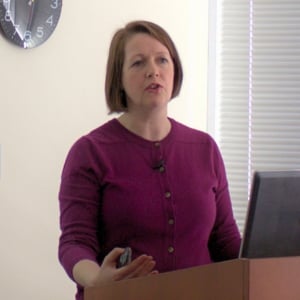
Karen Sagar
Project director and EDI lead for heavy civils infrastructure at Mott MacDonald
Expertise
Geotechnical, Design, Project ManagementLocation
West MidlandsMy highlights
Getting my masters degree (four years after leaving school and being told by the careers advisor I’d never get anywhere with one A-level)
Working on the Nemesis theme park ride at Alton Towers, Europe’s first ever inverted roller coaster!
2016 co-award winner of APEGA (Association of Professional Engineers and Geoscientists of Alberta) Women in Engineering and Geoscience Champion Award
A day in my life
While every day is different, I typically spend my time in the office working with my teams from the UK and internationally.
I spend a lot of time on MS Teams – liaising with my immediate team and my wider project teams. However, I do try to have as many in person meetings as possible.
As equity, diversity and inclusion (EDI) lead for our part of the business, I also check in with various employee resource groups and the executive board sponsor to help raise the profile for EDI and support events organised by our Advancing Network.
I knew I didn’t want to work in an office. I wanted to be outside and have a role that allowed me to travel, like my dad.
Engineering has allowed me to do both of these things.
I would recommend a career in civil or infrastructure engineering because…
...every day is different.
There's a huge variety of opportunities with contractors, client organisations and consultancies across varying sectors including transport, healthcare, energy, housing, among others.
There's the opportunity to influence the world around us, in many small ways, that can have a big impact on the future of our society.
We asked Karen…
When did you begin to see a connection between your neurodiversity and your professional strengths or challenges?
Following diagnosis two years ago, I started to look at my life and saw a lot of connections between some of my professional struggles and my AuDHD (the co-occurrence of autism and ADHD).
For example, I’ve always found conferences and after-work social events exhausting.
I now understand the connection between this and my neurodivergent sensory overwhelm and auditory processing challenges – meaning I cannot filter out the competing sounds like a neurotypical brain.
Do you find there are misconceptions colleagues or managers tend to have in relation to neurodiversity, that they could be educated on?
While it’s been great to see more people openly sharing their neurodiversity, I think there is still stigma around this (whether real or perceived).
This stigma is part of the reason why I make my neurodiversity known and visible at work, wearing my sunflower lanyard and sharing my experiences.
The business case for inclusivity has long been established, and this includes neurodivergent workers.
Most reasonable adjustments within the workplace are free or low cost and are generally not difficult to implement – we all, (whether neurodivergent or neurotypical), have communication preferences, or ways of working.
Being open to different ways of working and thinking uses the strengths of each team member.
Something I’d like to be more understood is what the spectrum (of autism) means – it’s not a linear graph starting at ‘not autistic’, going through ‘a bit autistic’ and ending at ‘very autistic’.
While an individual may struggle with their memory, or time management, for example, that doesn’t make a person ‘a bit autistic’.
The spectrum in fact represents our unique mix of individual strengths and challenges.
It needs to be understood as well, that our support needs also vary from one individual to the next.
Complete this phrase: I’m a geological engineer, but I’m also …
...the single parent to a teenager, an assistant scout group leader, and an EDI champion who helps others see the strength in their neurodivergence and intersectional diversity.
I'm also a passionate global traveller as I enjoy experiencing new foods and cultures.
How does your role contribute to addressing climate change?
Environmental considerations are a key part of our multidisciplinary design process.
Considering climate change helps to futureproof our designs.
Which individual project or person inspired you to work in civil or infrastructure
My dad!
He left school aged 13 to go to building college and ended up as a planning and finance manager for a major international contractor, working on projects around the world.
Name one civil or infrastructure engineering myth you’d like to bust.
That civil engineering is male-dominated.
While there's still a high proportion of men within the industry, over the course of my career, it has become increasingly diverse – for example, personal protective equipment (PPE) is now widely available for different body types!
In recent years, I've been involved in female-led projects which have opened the floor to different perspectives and conversations.
How has achieving ICE Fellowship impacted your career?
Gaining Fellowship has empowered me to feel that I can engage with senior leaders on a more equal footing.
Karen's career path
I have one A-level in geography, a bachelor's degree in science (geology with geography), and a masters degree in foundation engineering (geotechnics).
After leaving school with the expectation of a linear career path, my career saw me work as a designer for many years then step into people and project management, where I've had a varied and exciting career for the last 16 years, while still being involved with technical projects.