





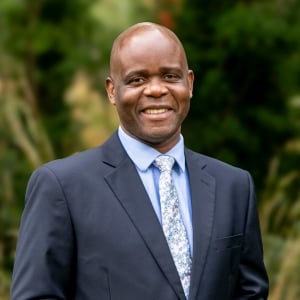
Hudson Taivo
Engineering manager, SYSTRA
Expertise
Project Management, Construction, DesignLocation
West MidlandsMy highlights
Presenting my paper on my work on HS2 to an international conference in Beijing, China
Becoming a Fellow of the ICE in 2021
Getting chartered in 2010, I put a lot of hours into that
I would recommend a career in rail because…
It’s a fulfilling career. You’re working on something that will directly impact people for many years to come, so the infrastructure must be designed well and run well.
I didn’t work on Crossrail myself, but I know a lot of people that worked on the line and they make sure to use it every time they go into London.
It makes me happy seeing people enjoy the infrastructure I contributed to.
What’s the most exciting part about being a rail engineer in the 21st century?
The most exciting thing about rail is how the technology has been shared all over the world. No single country is dominating the space. Even much smaller countries have high-speed rail. It isn’t limited to developed nations.
Passenger rail was started 200 years ago with the Stockton to Darlington Railway, followed by Australia a few years later. The first electrified railway arrived in Germany in 1881. Then, in 1964, high-speed rail started in Japan. It wasn’t limited to the UK.
All the changes that have happened in 200 years can be a microcosm of what will happen in the future. I’ve got a feeling that rail is going to be used even more with innovations in safety and design.
It’s going to be faster, more sustainable, and more affordable. When I was in China, they were talking about trains going at 400kmph, which is incredible. You could close the gap from Edinburgh to London and get there in two-and-a-half hours.
I’m sure either my kids or their kids will just take the best part of a day to go from North Africa to Southern Africa on a train. That will be great.
We asked Hudson…
A day in your life...
My day starts with emails. I check that things have been actioned from the day before or if anything needs to be signed off.
I also communicate with our client to see if they have any queries that need addressing.
I work mostly in the office, I think it’s important to be visible to my team.
I attend several meetings. My teams are based all around the world – in South Korea, Dubai, India, the Philippines, and Brazil – so we communicate mostly online.
Some days I visit our site at Park Lane Compound in Berkswell.
On top of being an engineering manager for the design, I also manage a team providing construction support, so it’s important for me to go onsite to make sure the construction is running well.
One of the best parts of my day is getting to speak to people about their work and learn about their projects.
What inspired you to work in civil engineering? And why did you specialise in rail?
I grew up in Zimbabwe, so like many others in my country, my parents said I had a choice of three careers: a doctor, a lawyer, or an engineer.
I really didn’t like wounds, so doctor was out. I wasn’t really any good at languages, so lawyer was out. I was good at maths, so engineering became a natural choice.
For a long time, I worked alongside rail engineers on projects like the Fehmarnbelt Tunnel, and during my time in Australia.
But it wasn’t until I got my job at HS2 that I worked in rail directly.
I didn’t have a rail background at the time, so I did a master’s at the University of Birmingham in rail systems integration, which was part-funded thanks to an ICE QUEST Scholarship.
What’s the most exciting project in rail at the moment?
I’m going to be biased towards high-speed rail, just because that’s what I’m working on.
We are seeing greater rail investment outside big countries.
Egypt has laid down the first few hundred kilometres of high-speed rail tracks and the finished project will be 2000 kilometres.
Morocco has completed part of a high-speed rail project and is investing more.
I also read in the papers recently that there are also proposals for a South African high-speed rail link between Johannesburg and the Limpopo at the border of Zimbabwe (my home country). This could connect families across borders.
They’re investing and they see the value in it.
What’s the biggest thing the public misunderstands about railways and how they operate?
Until I did my master’s course, I didn’t actually understand how rail is regulated in the UK.
For example, Network Rail doesn’t operate the trains, just the track. Then the train operating companies get access to the tracks.
Just to make it a bit more exciting as well, those operating companies don’t even own the trains that they use, they have to lease them from someone else.
Even the regulator only oversees Network Rail, not the operating companies. It’s quite a complex industry.
What do you think is the key to a society-wide modal shift towards public transport, particularly rail?
I think there are a couple of things. First is obviously the cost of tickets. If I commute between, for example, Tamworth and Birmingham, it costs me £10 for tickets and I need to park my car somewhere for an extra £6. If I use the bus, that will cost £5, and I can travel the whole way.
The second is convenience. Some of the transport is not integrated. So, when you get to the station, it needs to be easy to travel from there without a car.
You either need a bus or another form of public transport. At the moment, depending on where you live in the country, it’s not very convenient to use the trains.
Third is capacity. I see the reports of people being delayed and then they can’t even sit on the trains because they are full or they’re always late.
We need more people contributing to finding solutions. If it’s sustainable, it needs to be convenient, too, for people to use it. It’s about cost, convenience, and capacity.
How does your role contribute to making the industry more diverse and inclusive?
I’m an ICE reviewer and one of the things we want to do is encourage people from all backgrounds into the profession. The more diverse the workforce is, the more unique ideas you get.
For example, when you are designing infrastructure with only males in the room, you don’t get the full picture.
For me, I think just by being there and people seeing someone different, that itself inspires people.
I did a talk on becoming an ICE Fellow, and I know a lot of people who wanted to go for Fellowship who felt they could do it after seeing me.
People wanted to come talk to me and know more about what I did.
What role does digital technology play in your job?
I’ve been engineering for almost 25 years now.
When I started at university, we used to work around drawing boards.
When I began working, I used computer aided design (CAD), but it was all in 2D. Now we are using building information modelling (BIM), where it’s not just in 3D, but you can share the information with everyone in the team.
We’ve got teams based all over the world, from South Korea to Brazil, and we all work in a common data environment, so we can share information almost samlessly.
We can see changes almost immediately. It helps because, as an engineering manager, I’m not just looking at the design, but also how the trains will operate.
What motivated you to become professionally qualified?
I wanted the security that comes with chartership, knowing that I will be at an advantage when applying for jobs because I have a recognisable mark of my abilities.
Chartership also brings you confidence. When you’re chartered, people are assured that you know what you’re doing. Because of that, you feel more confident that you do know what you’re doing.
What does being professionally qualified with the ICE mean for your career?
If you’re a member of the ICE, you get local and international recognition. I’ve had a lot of challenges but finding a job has never been one of them.
Being a qualified member of the ICE who is active within the organisation does help with your career prospects. Getting the chance to work in Australia, for example, was partly because I was chartered.
What has achieving Fellowship meant for your career?
I didn’t think of it as something I could do, I thought you had to be extraordinary and doing a lot of difficult work.
Once I got over the line, I realised I was doing incredible work, and it wasn’t as difficult as I thought it was.
I’ve encouraged other people to apply to become Fellows since then.
Do you have any hobbies?
Outside of work, I like to spend time with my family. My son and I enjoy go-karting and will find time to race around the local track together when we can.
Hudson's career path
I did my bachelor’s degree at the University of Zimbabwe, then worked for a year back home before moving over to the UK.
When I decided to pursue chartership, I did a master’s degree in transport planning and engineering with Edinburgh Napier at distance, while working.
Then, when I was working in Australia, I wanted to move into management, so I worked for an MBA from the University of Warwick.
When I shifted into the rail industry, I wanted to enrich my understanding of rail engineering, so I studied for a master’s in rail infrastructure integration at the University of Birmingham.
Education has complemented my career at each stage, but it isn’t always formal. Often, it’s knowledge-sharing and learning from colleagues.
When I started out, the only way in the industry to be an engineer was to go through formal education, but it’s different now.
There are different pathways and people can choose the one that works for them.
Major projects
- In 2009-2010, I worked on the Fehmarnbelt Fixed Link, the world’s longest immersed tunnel between Denmark and Germany. This is currently being built following plans that I worked to put together all those years ago.
- The London 2012 Games. I worked on the surrounding infrastructure and the early designs of the warm-up tracks that people like Usain Bolt would eventually use. It makes me happy seeing that people actually enjoy the infrastructure I contributed to.


Related Content

- Type
- ICE Community blog
What's the foundation of flood resilience? Information
ICE President David Porter explains why being informed about flood risk is so important for the public and civil and infrastructure engineers.

- Type
- Awards and competitions
It’s electrifying! South Wales Metro track transformation bags top award
The electrification of the Core Valley Lines impressed the judges at the 2026 British Construction and Infrastructure Awards.

- Type
- Civil Engineer blog
The long-term consequences of a really good idea
Good decisions made at speed can lead the industry down unintended paths, writes Steven Yule, ICE country representative for the UAE.