

Sarah Piscitelli
Group director, WSP
Expertise
Project Management, Construction, StructuralLocation
ScotlandMy highlights
Being a project manager for Robroyston train station
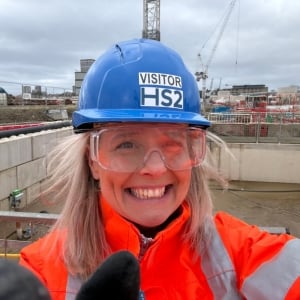
Landing a role on HS2
Working on the Cathedral Street bridge strengthening
A day in my life
No two days are ever the same, and that’s exactly what I love.
One day I could be in meetings, the next I’m jumping on a train (suitcase in hand!) heading to see a client or another WSP office.
It’s become a bit of a running joke at home, I even make the kids stop for selfies outside WSP offices when we’re abroad, which they love…
The one constant is that I connect with people every day.
I try to start well, with a gym session or a run with the dog, before the day quickly fills with what I enjoy most: talking, collaborating and solving problems.
At home, it’s a different kind of project management, playing taxi to various after-school clubs, squeezing in dog walks, and pulling together a (usually rushed!) family dinner.
Without engineering, we wouldn’t be able to travel, connect communities, or explore the world as we do today.
Civil engineers shape the lives of millions of people for the better every single day, but most of the time this impact goes unsung.
It’s time we changed that!
What inspired you to become a civil engineer?
Natural curiosity about the world around me, in particular the built environment.
As a child visiting Deep Sea World, I can still vividly remember the intrigue I felt as we drove over the bridge joints of the Forth Bridge. The rhythmic "dadum dadum" somehow captivated me far more than the 10-foot sand sharks waiting at the end of the journey.
When it came to applying for university, I applied for one course: Structural Engineering with Architectural Design.
In my mind, I wanted to create things that weren’t just functional, but beautiful. Things that would leave a legacy for future generations.
Growing up, whether it was having two big brothers or being immersed in my parents’ Italian restaurant, I’ve always been incredibly competitive and thrown myself fully into everything I do.
I was never really interested in toys, I much preferred being outdoors.
I was constantly trying to understand how the world around me worked, always pushing, testing, asking questions.
That need to understand how things are built and why they work the way they do, is what naturally led me into engineering.
And it’s never really left me. I still find myself walking around with my head swivelling in all directions, taking everything in.
And I still ask questions, because I’m still learning.
You can usually tell when I’ve spotted something interesting. I take a slightly deeper breath… and then it’s - “Did you know…? What do you think?”
We asked Sarah…
I would recommend a career in civil or infrastructure engineering because...
It never gets old!
There are no limits to what civil engineering can achieve, and that’s what makes it so incredible.
It shapes how we connect, move, and experience the world.
I still feel excited every time I go out on a site visit, which I believe is essential to learning, understanding and growing.
Seeing ideas being realised in real life never loses its impact.
Complete this phrase: I'm a civil or infrastructure engineer/technician, but I'm also...
...a people person who helps grow and connect colleagues, clients and future talent - something not often associated with engineers!
As well as being that person who forgets to put the bins out!
Name one civil or infrastructure engineering myth you'd like to bust.
There are two myths about engineering I’d like to debunk: that it isn't fun, and that it's not for everyone.
My STEM engagement has shown me the importance of bringing topics to life, taking your audience with you.
For example, to make bridge engineering relatable to school-age children, I might use my feet as foundations. Without them, I’d fall over.
Simple, relatable ideas can make complex concepts stick. Meeting kids where they are is key.
At one STEM event, I remember feeling proud that the classroom started using #bridgesrock in reference to our day together. I had helped them see engineering as something fun!
Another time, while volunteering on my son’s school trip, I could see the kids losing interest as I explained forces in an arch.
So, I switched it up and started talking about “catastrophic failure”. Suddenly, I had them hooked!
How does your role contribute to addressing climate change?
Climate change is increasing risks to our natural and built environments, and I believe my role contributes by shaping the culture in which we respond to those challenges.
By fostering a positive, forward-looking culture, I help teams think beyond “today’s design” and consider what infrastructure needs to perform like in the future.
This means encouraging people to challenge assumptions, collaborate openly, and design with resilience and adaptability in mind.
Applying a future-ready approach, I focus on understanding the specific context of each project, its location, environment and long-term risks. I ensure these factors influence decision-making from the outset.
Ultimately, my role is about bringing people together to think differently, enabling better, more sustainable outcomes that stand the test of time.
How does your role contribute to making the industry more diverse and inclusive?
When I started my career, I spent a lot of time trying to be who I thought I was meant to be.
I played down my love for bridges and trains, worried I might come across as overbearing or unprofessional.
To be honest, I still feel the need to rein in that childlike enthusiasm for these marvellous inventions - a feeling I try hard to ignore!
Over time, I realised that authenticity is far more powerful.
As my 20+ year career journey has unfolded, my role has evolved from project delivery and design into leadership.
Here, my passion for working with people allows me to bring together different personalities, perspectives and experiences to create stronger teams. The best part of the job: building people!
I fully embrace my “yellow personality” (a reference to Insights Discovery), which evidences my strong people focus and my dominant characteristics of energy and enthusiasm.
While I might work at 100 miles an hour, I know the best outcomes come from balance, so I actively surround myself with a mix of styles and ways of thinking.
By showing up as myself, I create space for others to do the same.
I champion the idea that there is no single “type” of engineer, and that diversity in personality, perspective and experience is what drives stronger teams and better results.
What role does digital technology play in your job?
Digital technology plays a key role in enabling effective design delivery at scale.
On major programmes, I rely on digital systems to manage large volumes of drawings and documentation, ensuring teams can collaborate efficiently and maintain a single source of truth.
It also supports coordination across disciplines, helping identify issues earlier and improve overall quality.
More importantly, digital tools enable better data-driven decision-making, allowing us to manage risk, track progress and optimise delivery.
Ultimately, digital technology is essential for bringing teams together, improving transparency and enabling more efficient, informed and integrated project outcomes.
What motivated you to become professionally qualified?
I’ve always believed that we are only limited by the boundaries we set ourselves. We are the guardian of our own destiny.
I’m incredibly driven and often hard on myself, constantly pushing to do better.
As with all of us, I can be prone to imposter syndrome. For a long time, I doubted whether I would be successful.
This meant I took a more gradual route to professional qualification, progressing through incorporated, then chartership, and ultimately Fellowship.
Each step built my confidence and reinforced my belief in what I could achieve.
A big motivation for me was the people around me. I love seeing my team grow and develop, and I realised I couldn’t encourage others to pursue chartership and Fellowship unless I believed in it myself.
I had to lead by example and push myself forward.
I have lots of people around me who tell me “you can do it”, so I try to do the same.
Watching people grow is what gets me up in the morning.
What does being professionally qualified with the ICE mean for your career?
It means everything!
Becoming a Fellow of the ICE, the highest honour for industry professionals, is something I’m incredibly proud of.
It represents recognition of what I’ve achieved so far, but more importantly, it inspires me to keep pushing further.
That recognition also opens doors. It broadens your network and gives you the platform and credibility to support and encourage others on their own journey.
For me, it’s not just about personal achievement. It’s about passing that energy and enthusiasm on to the next generation.
It’s what I set out to achieve all those years ago, sitting in the car pestering my mum and dad to drive over the Forth Road Bridge, “just one more time”.
When I found out I’d achieved it, the first person I wanted to tell was my late mum, which reminded me how much I really wanted it.
She would have been so proud. Sounds silly, but I took the dog for a walk up a big hill and took a moment to share it with her.
How did the ICE and your employer support you to become professionally qualified?
Through recognition, belief and encouragement.
My employer created an environment that provided opportunity, challenge and mentorship, while the ICE framework gave me the structure and clarity needed to progress.
The people around me supported and stretched me, helping me build confidence in my own ability.
That belief made the difference and encouraged me to achieve professional qualification.
Any personal causes or hobbies?
I love running and going to the gym. I’m by no means fast, but I really value the thinking time.
It’s when I can reset, reflect, and work things through.
There’s nothing quite like releasing a few endorphins to put everything back into perspective.
Also, I must be influencing my running buddy, who has started pointing interesting infrastructure out to me. Win!
If you were to ask my kids about my hobbies, they’d definitely say trains and bridges!
It’s become a bit of a family theme. If we go on a train journey, it quickly turns into “mum’s day”! Their dad rolls his eyes, but I’m sure that, despite calling me cringe, I still catch him smiling.
Recently in Vietnam, the kids even planned a visit to Train Street and an overnight train journey.
They can now tell you about different bridge types, the differences between them, and even where a train will stop on a platform depending on the number of carriages. All perfectly normal chat in our household!
My daughter often says, “Mum, it’s just your thing!” And she’s absolutely right.
Having recently shared my Fellowship news on LinkedIn, my son is convinced I’m going to be “LinkedIn famous”. Apparently 300+ likes is all it takes!
He is my biggest fan and thinks his mum’s passion and enthusiasm for bridges and trains is cool.
Sarah's career path
My career has been shaped by curiosity and a constant drive to explore opportunities. It’s very much a reflection of my personality.
I began with Amey on a summer placement and was immediately hooked. I loved the work and was keen to learn more, so I was delighted to secure an undergraduate role (on the condition I could rotate across different disciplines).
Although I spent much of my time undertaking bridge inspections and writing reports, I particularly enjoyed being onsite.
Over time, though, I realised something was missing. I’m someone who sees opportunity everywhere, and I wanted to create, innovate and shape outcomes, not just review them.
I moved to Jacobs in a structural engineering role, where I gained valuable technical experience.
After having my daughter, I initially thought I should step away from work. But within a year, I realised that wasn’t my true self.
Less than two weeks later, I joined WSP. Since then, my career has evolved alongside the business.
Starting in civil bridge and ground engineering, I gradually moved into rail as my projects became more specialised.
Along the way, it became clear that I thrive on the people side of the business.
Today, I lead a group within the project management and commercial management (PMCM) group within the rail sector.
For me, working for an organisation like WSP means I’m never short of opportunities to grow and take on new challenges. What’s next? Who knows, that’s the exciting part.
As a Fellow of the ICE, there are no limits.
Major projects
- Cathedral Street Bridge Strengthening: what felt like my first 'grown-up' engineering project, where I even got to decide the colour of the bridge!
- Robroyston Station: overseeing the installation of Scotland’s first glass reinforced plastic (GRP) platform
- High Speed 2 (HS2): working on everything from tunnel construction to how the whole system integrates