

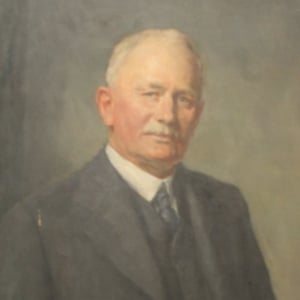
Sir David Anderson
Civil engineer and ICE past president
Expertise
Bridges, Rail, Construction, GeotechnicalLocation
United KingdomMy highlights
Working with Sir Basil Mott on the City and South London tube railway
Constructing the Tyne Bridge in Newcastle
Working on the pioneering Queensway Road Tunnel in Liverpool
Why you might have heard of Sir David Anderson
Sir David Anderson, the ICE’s 79th President from 1943-1944, was a Scottish civil engineer known for building tunnels and bridges across the UK with firm Mott, Hay & Anderson.
Alongside his partners, Sir Basil Mott and David Hay, Sir David worked on notable projects such as the Queensway road tunnel between Liverpool and Birkenhead. When it opened in 1934, it was the longest road tunnel in the world.
The firm also designed the Tyne Bridge in Newcastle and the Forth Road Bridge in Scotland.
Sir David was forward-thinking in nature, with his presidential address highlighting the importance of planning and engineering expertise.
He was conscious of the Earth’s finite resources, and the need to explore other avenues, such as renewable energy.
“It is doubtful whether anyone has studied how long the raw materials of the world will last. Less wasteful use of them badly requires investigation,” he said in his address.
Meanwhile, he added: “such sources of power as the tides, the sun, and the wind are largely untouched.”
It does not seem to be realised that if engineers failed in their work modern life as we know it would break down.
Trains would cease to run, roads and bridges. would give way, there would not be any water, gas, or electricity in our towns, and disease would spring up.
Sir David Anderson, from his presidential address
Learn more about Sir David
Education
Sir David Anderson attended Dundee High School in eastern Scotland.
He obtained a Bachelor's of Science degree in civil engineering from St Andrews University in 1900.
Career
Sir David began his career in Glasgow, training under Sir William Arrol and Company, bridge builders and general steelwork firm.
In 1905, he moved to London to work under Sir Benjamin Baker, an ICE Past President known for his work on the Forth Railway Bridge and the London tube railways.
Sir David was appointed resident engineer for the widening of Blackfriars Bridge in London, work that was led by his future business partner, Sir Basil Mott.
Sir David was chief assistant to Sir Basil on the Southwark Bridge and Rochester Bridge construction.
He was also involved in many of the works on the City and South London tube railway.
World War I
During the first world war, Sir David served in the Royal Engineers. He completed his military service as a captain.
Mott, Hay and Anderson
Following his return from the war, in 1923, Sir David joined Sir Basil and David Hay’s partnership to create Mott, Hay and Anderson (today Mott MacDonald).
Post-war, the firm worked on several large bridge and tunnel projects, such as:
- Queensway Road Tunnel
- Dartford Tunnel (though works were paused due to the outbreak of World War II, and restarted in 1959)
- Railway and escalator tunnels for the London Underground
- Tyne Bridge
- Wearmouth Bridge
- Tees Newport Bridge
The firm also consulted on the then proposed works for the Channel Tunnel and designed the suspension bridges that would become the Forth Road Bridge and the Severn Bridge.
Sir David designed the pedestrian and road tunnels under the River Tyne.
ICE presidency during times of war
World War II's end was still some time away when Sir David became president of the institution in November 1943.
During his presidential address, he referred to the first and second world wars being known as 'engineers' wars'.
He explained: “More and more, warfare has become a matter of machines hurling death and destruction all around them. Men kill and drown each other from miles away.”
He lamented that engineering talent should be put to this use.
“The engineer’s skill and ingenuity in the design of tanks, guns, bombs, and aeroplanes has unfortunately led to the creation of instruments for the destruction of his own and other peoples,” he said.
“But surely the skill and ingenuity that have been used for purposes of destruction in time of war can be used, and should be used, for purposes of construction and improvement in times of peace,” he went on to add.
His address touched on the level of reconstruction works that would be expected in the UK after the war.
Sir David served on several technical committees for the UK government and chaired a number of them.
Personal life
Sir David was born in Fife, Scotland on 6 July 1880. He died in Fife in 1952, aged 72.
He married Isabella Corbet Anderson of Dundee. She passed away in 1929.
He re-married in 1935, to Agnes Gilchrist Anderson.
Did you know?
Sir David Anderson inspired his great nephews to become engineers and some even joined the institution, making that four generations of ICE members!

Notable projects
- Queensway road tunnel, Liverpool
- Blackfriars Bridge widening, London
- City and South London tube railway
- Southwark Bridge, London
- Rochester Bridge, Kent
- Tees Newport Bridge, Middlesborough
- Forth Road Bridge, Scotland
- Severn Bridge, England and Wales
- Wearmouth Bridge, Sunderland
- Tyne Bridge, Newcastle
- Tyne tunnels, Newcastle
- Consulting on the Channel Tunnel
Membership of societies
- Sir David became an associate member of the ICE in 1906 and a full member in 1915
- In 1930, he was elected to the ICE Council, and was president of the institution from 1943-1944.
- He authored several papers, which he presented to the institution
- He was a member of the American Society of Civil Engineers.
- He was made a knight bachelor in 1951