





ICE Knowledge Hub
Access the very latest and best CPD content to help you grow your knowledge and skills.
Sign in now

Good decisions made at speed can lead the industry down unintended paths, writes Steven Yule, ICE country representative for the UAE.

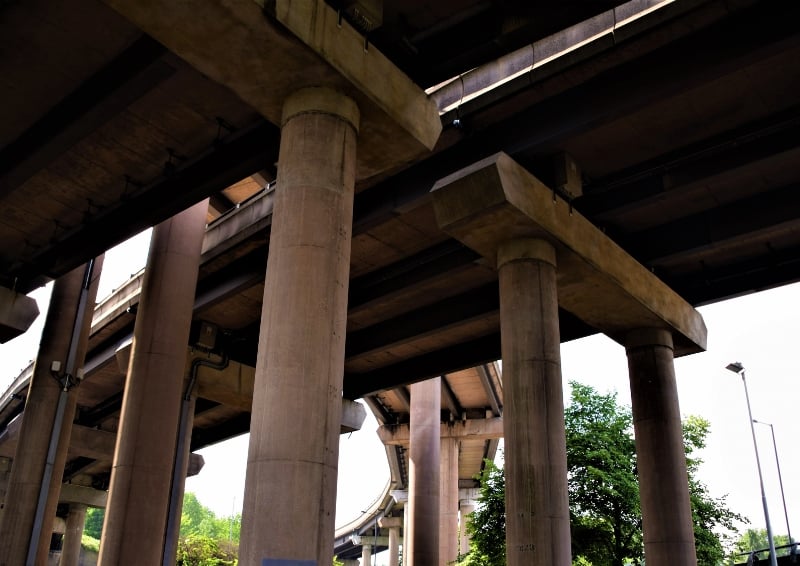
On a wet and grey winter's morning in Birmingham, I stood beneath M6 Junction 6, Gravelly Hill, the interchange everyone knows as Spaghetti Junction.
Down there, it’s strangely peaceful, the traffic overhead no more than a hum and nobody else around.
Above me, the motorway had been reduced to a single lane under restriction.
A temporary propping system was carrying part of the structure, and one of my jobs that morning was to climb up and check the jacks, monitoring the loads they held.
I was a young structural engineer, standing beneath a junction that opened in 1972, well over a decade before I was born.
One of its half joints could no longer be relied on under even its permanent loads, so while the props did the work, we were designing a permanent pier to do it for good.
Half joints were everywhere in that era of bridge building, and for good reason.
A beam is halved in depth at its end and seated on a matching nib on the supporting structure, creating an internal hinge that keeps the structure simple to analyse and tolerant of movement.
The detail suited precast elements, allowed rapid construction and kept the carriageway level. In the late 1960s, with the motorway network being built at pace, those were exactly the right problems to solve, and the half joint solved them well.
What the detail could not tolerate was time. Its weakness lies above it, in the expansion joint at road level.
British roads are salted every winter. When a deck joint fails, water carrying de-icing salt finds its way through and pools on the concrete beneath.
Chlorides penetrate the concrete, the reinforcement behind the cover corrodes, the concrete cracks, spalls and delaminates (meaning it chips or breaks away), and the steel and the concrete gradually stop working together.
Aspects of the reinforcement detailing, judged by what was learned later, compounded the problem.
All of this happens in a region that is nearly impossible to inspect.
Repairs, waterproofing and protective measures such as cathodic protection have slowed the deterioration ever since.
A detail chosen partly for how quickly it could be built now has its own national standard and research programmes.
It would be easy, and unfair, to be critical of the designers. They were solving the problems in front of them with the knowledge of the time, and they solved them well.
The consequences arrived on a different timescale, and they landed on somebody else.
On that winter morning they landed on a young engineer managing works instructions, specifications and design checks for the pier that would take the load the joint no longer could.
I have since made a version of the same kind of decision myself.
On a complicated infrastructure programme in the Middle East, under significant time pressure and with a great deal riding on the outcome, we needed an innovative solution and we found one.
It worked, the outcome was a good one and I’m still proud of it.
Only when reflecting on it later did I see the parallel.
The decision had been entirely focused on the problem in front of us, and the long-term implications had not been looked at.
I bear that in mind now, because the same pattern could repeat anywhere.
Engineering is adopting new technology, AI among it, at pace and largely on the promise of speed.
Some adoption decisions can be unwound cheaply, a tool swapped, a subscription allowed to lapse.
Others get cast in, embedded in data, workflows, contracts and habits until the cost of leaving dwarfs the saving that justified them.
Take a system that holds an organisation’s asset records. It arrives to do one job and does it well.
Over the years it also settles how assets get named and numbered, and what counts as a defect.
Nobody decided that, it just happened, and by then a generation of staff has learned the job through it.
Move to something else 15 years later and the records migrate without much trouble, but the decisions embedded within them do not. Every record and drawing built on the old naming has to be reconciled with the new, and none of it appeared in the business case.
As with the half joint, the region you most need to inspect – how deeply a choice has worked itself into your information and your ways of working – is the hardest to reach when you need to.
An engineer could reasonably object that the comparison flatters itself. A half joint is cast into a structure still standing 50 years later, while software is replaced every few years.
That is true of the tool, but it’s the wrong thing to measure. What lasts is the shape it leaves behind, in how the work is organised and in what a contract obliges you to keep supplying.
At Gravelly Hill the people who chose the detail were long gone by the time somebody had to hold the deck up.
Parts of the technology world already treat this as a discipline, with exit plans and reversibility written into adoption decisions before they are made.
Engineers should recognise the instinct, because it is the same one that makes us design for inspection and maintenance.
So before adopting the next tool or platform, it’s worth asking: how deeply will this embed itself in our ways of working, and what would it cost to leave?
Spaghetti Junction still stands, still carries a city's traffic every day, and still acts as a vital artery for the nation's economy. It’s kept in service by continuous and often ingenious care. Half joints were a really good idea, and good ideas are how we keep moving the profession forwards.
The discipline this story asks of us is simply to know, while the choice is still cheap, which of our decisions we are casting in.
Read the ICE State of the Nation 2026 report on delivering the UK's infrastructure strategy and managing its ageing assets.


The annual award celebrates outstanding ideas, research and best practice.

The ICE breaks down the headline announcements from five of the major UK parties.

A new standard, which will guide the sector in improving productivity, is set to launch in 2026.