





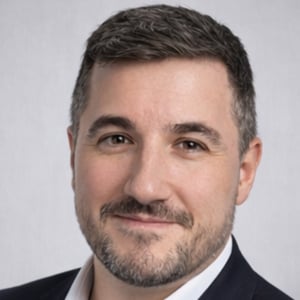
Steven Yule
Director of digital and data, Jacobs
Expertise
Project Management, DigitalLocation
UAEMy highlights
Leading the digital and data work behind Riyadh's Integrated Infrastructure Coordination Plan, which coordinates works across the whole city to prevent clashes
Developing a digital twin strategy for the Transpennine Route Upgrade, in collaboration with the University of Cambridge Centre for Smart Infrastructure and Construction
Becoming a Fellow of the ICE at 36, and later taking on the role of country representative for the UAE
A day in my life
The working week in the UAE runs Monday to Friday, with long days early in the week and a half-day on Friday.
Mine usually starts around 8, either checking emails at home or taking the metro into the Dubai office.
Mornings fill up with calls, some about projects, some about winning new work, with clients in the UAE and Saudi Arabia.
My team includes engineers of every kind, plus economists, mathematicians, and software architects. So much of my job is getting all those minds focused on the same problem.
Office days finish around 6. I save calls with the US for home-working days, so I'm not stuck late in the office.
Since having a family, I guard my evenings and weekends more. We all need time to recover and to do the other things that make life good.
What inspired you to become a civil engineer?
A summer placement with Arup's structures team in Liverpool in 2008, working on the university's buildings.
The main one was the Victoria Building, the original red-brick structure that gave us the phrase "red-brick university", which was undergoing restoration and then some follow-on work. I also did a small design piece on the upgrade to the engineering buildings.
It was the building my own department sat in, at the university where I was studying civil engineering, so it felt very close to home.
Working to keep a historic building alive and useful for another century, alongside some genuinely talented engineers, settled it for me.
It also taught me what technical excellence looks like, which I've carried ever since.
We asked Steven…
I would recommend a career in civil or infrastructure engineering because...
Most of us go into it because we want to make the world a bit better, and infrastructure is one of the foundations of civilisation.
You don't miss a bridge until it's gone. The unseen stuff, the water, the power, the roads and the railways, is what lets everything else happen.
My own work has changed a lot over the years, but that idea still holds.
Helping a water company find leaks faster affects real households.
Helping a city coordinate its roadworks means thousands of people aren't sitting in traffic every morning.
You rarely get thanked for any of it, which doesn't really matter because you know you made a difference.
Complete this phrase: I’m a civil engineer, but I’m also …
...endlessly curious.
I like learning new things and I'm especially interested in the history of the places I live.
When I moved to Dubai, I read everything I could about how the city was built, partly because the firm I work for was involved in much of the early work here. This includes the Creek, Al Maktoum Bridge, Al Shindagha Tunnel, Port Rashid and Jebel Ali.
It's the same foundational infrastructure story, just somewhere hotter.
Name one civil or infrastructure engineering myth you'd like to bust.
That civil engineering is low-tech.
People hear the words and picture concrete, steel and hard hats, and those things still matter, because somebody has to build the thing.
But this is a career that already uses technology heavily and will use a great deal more, and none of that removes the need for engineers.
However clever the software gets, somebody still has to make the judgement call and be accountable for it, and that isn't something you can hand to a computer.
Somebody from a tech company can't do a civil engineer's job, because they don't have the context to know when the answer on the screen is wrong.
Technology is an evolution of what we do rather than a replacement for it, and our job is to make sure engineers are equipped to use it well.
How does your role contribute to addressing climate change?
The greenest infrastructure is often what we already have.
So much of my work focuses on understanding assets properly so they can be properly maintained and kept in service rather than rebuilt.
I also worked on a pilot for the UK Department for Transport, using data to measure carbon across the whole life of rail infrastructure, including the carbon embedded in the materials themselves.
You can't reduce what you can't measure, and better data leads to better decisions.
How does your role contribute to making the industry more diverse and inclusive?
I work with engineers from all over the world here in the UAE, and part of my ICE role is to ensure everyone can access the same professional support and recognition, wherever they trained.
I also devote a lot of time to early careers through the ICE committee, the Early Careers Network and various awards.
I spent years as a supervising civil engineer, helping people towards Incorporated and Chartered status, and these days I spend more of that time helping people towards Fellowship.
What role does digital technology play in your job?
It's essentially the whole job.
I spend my time helping infrastructure organisations work out where digital tools and data genuinely help, and where good old-fashioned engineering judgement still matters more.
What motivated you to become professionally qualified?
Honestly, I started because it seemed like the natural next step and everyone said I should.
The urgency came from moving to Doha and worrying I might not get the right projects to qualify. As it turned out, I did.
The real understanding came later, with the competences, the framework behind it, and the depth of the ICE.
That understanding is what took me on to Fellowship.
What does being professionally qualified with the ICE mean for your career?
What I didn't expect was how well it travels.
Working internationally, CEng (Chartered Engineer) and FICE (Fellow of the ICE) are recognised and respected everywhere I've worked, and that gives people an immediate assurance about your experience, which opens doors.
How did the ICE and your employer support you to become professionally qualified?
I was at Amey at the time and had a good delegated engineer and a supervising civil engineer behind me.
Ultimately, I had to drive it myself, but I was lucky to be surrounded by chartered engineers I respected.
Seeing them was what made me want to reach that standard.
How has being a member helped your career?
Mostly it's been the network, because wherever I've worked there have been ICE members to learn from.
It's also given me ways to give back, first on the UAE committee, then leading it, and later as country representative and as a Policy Fellow.
How has achieving Fellowship impacted your career?
I woke up the next day as the same person, but what really changes is the weight the letters carry.
People watch what you do and listen to what you say a bit more closely, which brings real responsibility, so you have to treat that trust carefully.
It cuts both ways, because if people are listening, you need to be sure of what you're saying.
Becoming country representative for the UAE has been the most rewarding part of it.
The role puts you between the institution and its members, and it has taught me a lot about how the ICE actually works while letting me support members directly.
What’s the biggest/most complex thing you’ve made out of Lego?
Not Lego, but a Meccano bridge. I was involved in the one built at Liverpool's Pier Head in 2009 for James May's television series, put together by students from the university.
It was a good example of what happens when people come together to solve a problem, and what you can actually build.
Where do you get your engineering inspiration?
I get most of it from history, not only from the things that were built but also from the people who built them.
We probably have fewer engineers we can name and look up to these days, because so much of the work is now done behind large company names rather than by individuals.
I've always found the people more interesting than the structures, past and present.
Anything else? i.e. personal causes, hobbies
Developing the next generation matters to me.
Through the ICE committee, I've worked with the Early Careers Network and on early careers awards, and I give time to learned society events and to helping members write and publish papers.
Steven's career path
I hold an MEng in Civil and Structural Engineering from the University of Liverpool.
I started with Amey in Birmingham, working on bridge design and rehabilitation, then moved to Doha to work in highways operations and maintenance, and asset management.
Back in the UK with Jacobs, I moved into strategic advisory and worked across sectors, including rail, which gave me a whole-life view of infrastructure. I then moved to the Middle East to set up the digital and data business.
I was chartered with the ICE in December 2016 and elected a Fellow in July 2021. I am also a Fellow of the Chartered Institution of Highways and Transportation, a member of the Institute of Asset Management, and a Freeman of the Worshipful Company of Engineers.
In 2026, I was appointed non-executive director of Thomas Telford Limited (TTL).
Major projects
- Transpennine Route Upgrade, UK
- Riyadh Infrastructure Projects Center, Integrated Infrastructure Coordination Plan, Saudi Arabia
- Etihad Rail, stages 2 and 3, UAE


Related Content

- Type
- Civil Engineer blog
The limits of efficiency: not every slow step in engineering is waste
Steven Yule, ICE country representative for the UAE, asks which slow steps in engineering AI should not remove.

- Type
- Civil Engineer blog
Engineers, if it’s not in the contract, it’s unlikely to happen
The project outcomes we want only become real when they’re written down where they carry consequences, explains Steven Yule, ICE UAE country representative.

- Type
- ICE Community blog
When every consultancy looks the same, where does innovation go?
There’s no shame in making a name for yourself in a consolidated industry, writes Steven Yule, ICE country representative for the UAE.