

Year
2025Duration
34 monthsCost
£65mLocation
United KingdomProject achievements
Solved the problem
Protects more than 6,000 homes and businesses from tidal flooding
Environment benefitted
The site operated diesel-free for up to 85% of the summer
Used engineering skill
Installed a modern revetment system using lean sand asphalt and open stone asphalt
Protect thousands of properties from flooding for the next 50 years
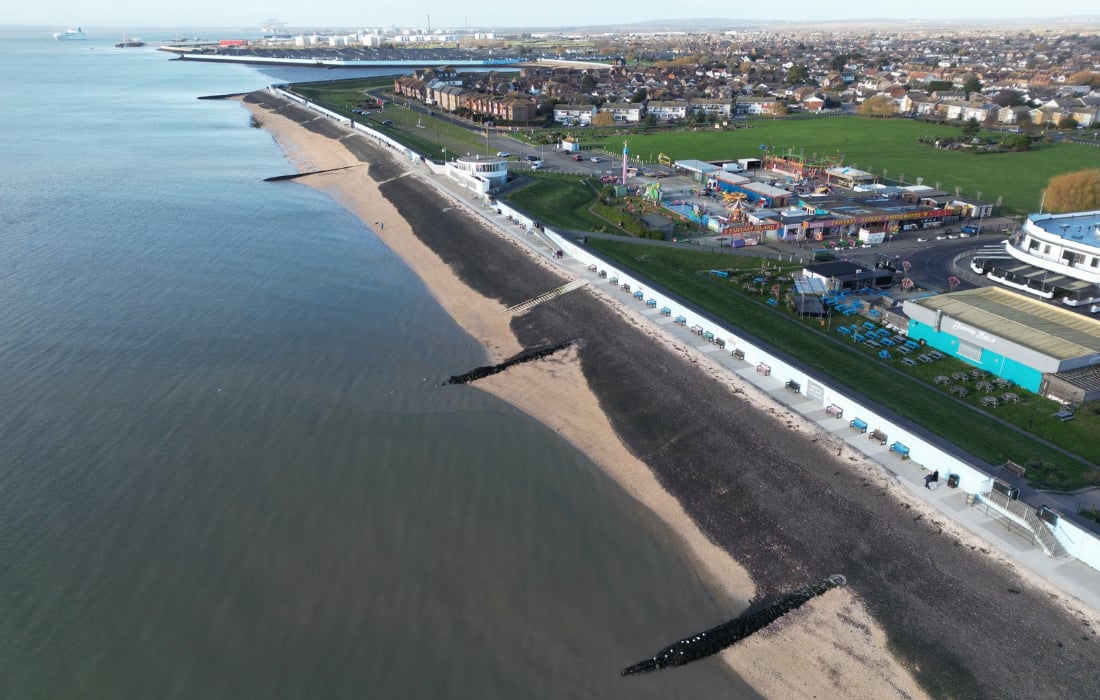
The Canvey Island Southern Shoreline project refurbished and upgraded 3.2 km of tidal flood defences as part of the Environment Agency’s TEAM2100 programme.
TEAM2100 stands for Thames Estuary Asset Management 2100. The £450m flood management programme started in 2015, and is the largest of its kind in the UK. It seeks to protect London, Essex and Kent from tidal flooding along the River Thames.
The £65m project at Canvey Island covers more than 6,000 homes and businesses, with the aim to safeguard the area for the next 50 years.
The scheme replaced ageing revetments, installed new foreshore access steps at 17 locations and repaired sections of the maintenance track.
Delivered through an integrated team made up of the Environment Agency, Jacobs and Balfour Beatty, the project combined technical innovation with collaborative working to develop the most effective solution for this challenging estuarine environment.
Did you know …
-
Without the flood defences, Canvey Island could be flooded by the tide twice every day.
-
The site operated diesel-free for up to 85% of the summer. Solar-powered compounds, battery storage and electric vehicles helped significantly reduce carbon emissions.
-
Construction could only take place during a five-hour low-tide window. Teams had to carefully plan and sequence works around this.
How was the work done?
Having thoroughly considered several alternatives, the project team decided to pursue a modern revetment system using lean sand asphalt (LSA) and open stone asphalt (OSA).
LSA provides an impermeable and structurally robust foundation, while OSA reduces wave energy, improves drainage and enhances durability.
Compared with traditional rock armour, concrete and plastic-based systems, the solution offered a more resilient, maintainable and lower-carbon approach with reduced whole-life costs.
Before construction started, the team carried out extensive checks and testing, including technical reviews, material approvals, trial panels and mix-design development.
Working closely with specialist supply chain partners, the team tailored the solution to the shape, slope and hydrodynamic conditions (how water behaves at a particular location) of the shoreline.
Cost, risk and programme management were integrated with design reviews, temporary works design and buildability assessments. Meanwhile, digital data capture and shared dashboards improved visibility across the programme and supported right-first-time delivery.
Construction presented a number of significant challenges.
Operations onshore were restricted to a five-hour low-tide window each day, requiring meticulous planning and real-time monitoring of tidal and weather conditions.
To maximise productivity, key elements such as access steps were manufactured off site and installed using precast construction techniques. When tidal conditions prevented shoreline activities, work was redirected to other areas to maintain progress.
Seasonal tourism also limited operations around popular coastal locations during the summer months. Engaging stakeholders early on enabled the team to phase construction around visitor patterns and keep the public safe during delivery.
Difference the project has made
Completed in July 2025, the £65 million project has significantly reduced flood risk for residents, businesses and infrastructure while improving resilience to climate change.
The scheme also delivered substantial environmental benefits. The installation of artificial rock pools within the local site of special scientific interest (SSSI) enhanced biodiversity, and innovative low-carbon materials reduced embodied carbon compared with traditional construction methods.
A standout achievement was the project becoming the Environment Agency’s first site to undertake a controlled four-week trial of a hydrogen fuel-cell generator.
Delivered with Sunbelt Rentals, Hydrologiq and EODev, the initiative explored practical alternatives to diesel-powered site operations.
The generator provided 24/7 silent power, produced more than 3,000 kWh of clean energy and saved over 4,000 kgCO₂e, enabling the site to operate up to 85% diesel-free during the summer months.
The lessons learned have since informed wider TEAM2100 and Environment Agency innovation programmes, helping to shape future adoption of ultra-low-emission technologies across flood and coastal defence schemes.
Alongside local employment, educational engagement and community initiatives, the project has delivered a lasting legacy for the environment and the people of Canvey Island.
Project milestones
Contract starts under the Environment Agency's TEAM2100 programme
Site works begin on the Canvey Island Southern Shoreline scheme
Flood defence works completed ahead of time, protecting over 6,000 properties for the next 50 years
People who made it happen
- Stefan Attfield – Balfour Beatty
- Charles Stotesbury – Balfour Beatty
- James Mason – Environment Agency
- Duncan Cunningham – Jacobs