





ICE Knowledge Hub
Access the very latest and best CPD content to help you grow your knowledge and skills.
Sign in now

A resilient highway network mitigates disruption by allowing people, goods and services to keep moving.

Valued at £21 billion, the Wales Strategic Road Network (SRN) is the Welsh government’s most valuable infrastructure asset, spanning 1,000 miles of trunk roads and 75 miles of motorway.
It’s vital to Wales’ socio-economic infrastructure, supporting safe and inclusive public transport, walking, wheeling and cycling, car travel and freight.
The SRN caters for around one third of all journeys undertaken and approximately 93% of all road freight transported in Wales.
It connects communities, businesses, ports, hospitals, education, tourism destinations and cross-border markets.
When the SRN is disrupted, the consequences can be significant, affecting communities, economic productivity and public safety.
A resilient highway network mitigates disruption by allowing people, goods and services to keep moving.
It limits negative impacts to communities and business while maintaining access to essential services, such as education and healthcare, and supporting the economy.
A resilient highway network depends on proactively maintaining infrastructure, identifying risks early, responding to incidents effectively and planning for the long-term.
Recognising that the resilience of the SRN can be improved, the Welsh government’s Strategic Road Network Division is undertaking a Transportation Needs and Resilience Review (TNRR) of major routes. This includes the A55, A494 and M4 motorway.
The review helps the Welsh government understand how well the network is working and identify where changes are needed.
It looks at all forms of transport, using data and evidence to support long-term plans and policy, including Llwybr Newydd: The Wales Transport Strategy.
The TNRR provides a clear picture of transport needs, system performance, and network resilience, with a focus on:
The review is considering targeted improvements schemes, major asset renewal, structural works and other route objectives.
In its role as highway authority, the Welsh government is working through its maintaining agents – the North and Mid Wales Trunk Road Agent (NMWTRA) and the South Wales Trunk Road Agent (SWTRA) – to deliver projects that improve the resilience of the SRN.
Climate change is a major pressure on network resilience, highlighted by the disruption caused by named storms Bert, Darragh and Éowyn during winter 2024-2025.
Storm Darragh triggered a rare Met Office red weather warning with winds reaching up to 93 mph. It caused widespread treefall across Welsh forests, country parks, cities and sections of the SRN, downing power lines and blocking roads.
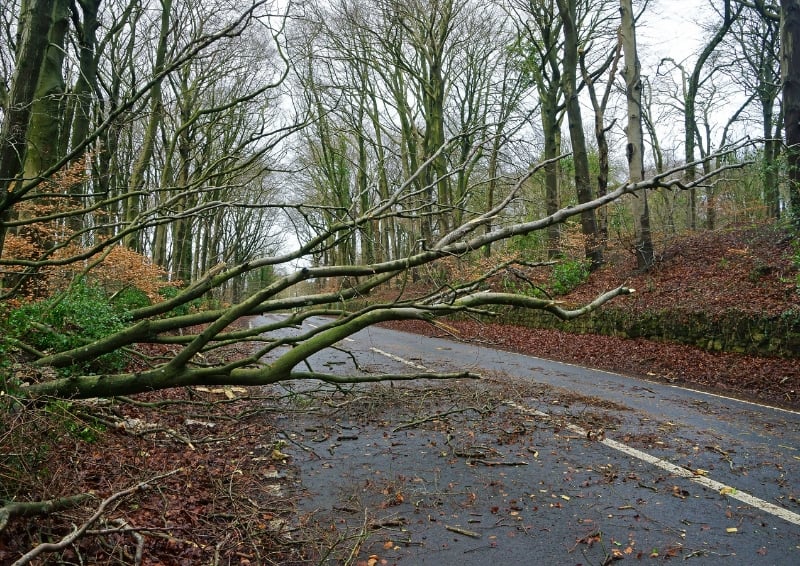
To reduce the risk from falling trees, the Welsh government continues to clear front edges and remove dangerous trees along the M4 and other parts of the network.
Front edge clearance helps keep the road network safe by reducing the risk of trees and branches falling onto the carriageway, helping to prevent road closures and disruption for road users.
At the same time, well-managed roadside plots can support a greater variety of native plants and wildlife, improving habitat quality and ecosystem resilience.
When undertaken sensitively, front edge clearance delivers safety and biodiversity benefits, creating a road network that is safer, more resilient and better for nature.
At the time of writing, the summer of 2026 has produced five heatwaves, with temperatures reaching up to 38°C.
Roads that use bitumen as binders generally don’t become “soft” until they reach temperatures of around 50°C.
While the UK has only experienced prolonged periods where the air temperature has ranged from the mid-20s to the high 30s, surface temperatures can easily exceed the 50°C threshold because the dark grey-black asphalt absorbs and retains heat.
When bitumen softens, the structure of the pavement is weakened, making it vulnerable to rutting (wheel-track grooves) and surface deformation under heavy traffic.
Until 2017, the Welsh government mainly used road surfacing materials that contained an unmodified, medium-grade bitumen, known as straight run 40/60 / 50pen.
The 40/60 material works effectively between -8°C and +52°C, which may impact network resilience if hotter summers become commonplace.
In 2017, while developing its Welsh Government Stone Mastic Asphalt (WGSMA) material, a premium Polymer Modified Binder (PMB) was chosen.
This material remains effective from -29°C to 85°C, making it much less likely to soften and fail during periods of extreme heat.
The material also contains fewer air gaps, which can help roads last longer and slows the oxidation of the binder material. This could increase the amount of reclaimed asphalt that can be used in future resurfacing projects, helping to cut down carbon emissions from road maintenance.
The Port Talbot section of the M4 is a critical resilience point of the SRN. Disruption here would have major impacts on connectivity and freight movement.
This section includes four multi-span reinforced concrete viaducts, built in the mid-1960s, which all differ in design and construction.
Following inspections, the Welsh government and SWTRA commissioned AtkinsRéalis to assess all four viaducts against current highways standards. The assessments considered their condition, how they have deteriorated over time, and how they are used today.
AtkinsRéalis will be sharing its structural assessment process at the upcoming ICE Resilient Transport 2026 conference, taking place in Manchester this September.

This work has enabled the Welsh government and SWTRA to apply a targeted asset management strategy for the ageing structures, showing how structural assessment can strengthen resilience in an existing transport network.
Together, these actions and multiple other activities are helping the Welsh government to operate and maintain a functioning and resilient strategic highway network.
Find out how you can build resilience into your transport networks by attending the ICE Resilient Transport conference this September.


Candidates who meet the requirements are invited to stand to represent the institution as a future president of the ICE.

The Infrastructure Client Group's 2026 benchmarking survey shows progress, but greater focus is needed on value, data quality and delivery outcome.

Andy Burnham has brought an injection of energy into Britain’s top job. But what does his tenure spell for infrastructure?