





As global temperatures continue to rise, engineers need to plan for the impact that extreme heat has on infrastructure, writes ICE President Professor Jim Hall.
This blog was programmed for the summer of my presidential year before I knew what the weather would be this month.
A wet summer would not be an apt setting for a blog on extreme heat.
But based on the last two decades, it was a pretty safe bet that the summer would be hot. And it has been, with the summer dealing us three heatwaves so far.
With the last 10 years being the hottest on record globally, it’s fairly safe to assume that our summer will continue to get warmer.
What causes extreme heat?
Global mean temperatures have increased by 1.47°C since pre-industrial times. As land heats faster than the oceans, that means we’ve seen an average increase of 2.2°C over the land in Europe.
This matters because a relatively small shift in the mean temperature can dramatically increase the number of extremely hot days in the year.
In England, the number of ‘hot’ days (>28°C) has more than doubled, and ‘very hot’ days (>30°C) more than trebled.
The impact of extreme heat
Indirect effects
A warming planet causes the oceans to expand, ice to melt (in mountains and ice sheets), and enables the atmosphere to contain more water.
The former leads to sea level rise, the latter to the potential for more intense rainfall.
Direct effects
Impacts that are more directly linked to extreme heat include wildfires and increasing dry weather, or aridity.
Devastating wildfires have rendered shocking images of impacts on wildlife, people’s homes, buildings and infrastructure.
The causes of wildfires are quite complex, but temperature and aridity are very important drivers.
Here comes a paradox: a warmer atmosphere can hold more water, but we also expect land to be drier, at least during the summer.
That’s because increasing temperatures drive up evaporation and transpiration (evapotranspiration) from the soil and plants.
How do heatwaves and extreme temperatures affect infrastructure?
Extremely hot temperatures can impact our water, transport, energy, and social infrastructure.
Water infrastructure
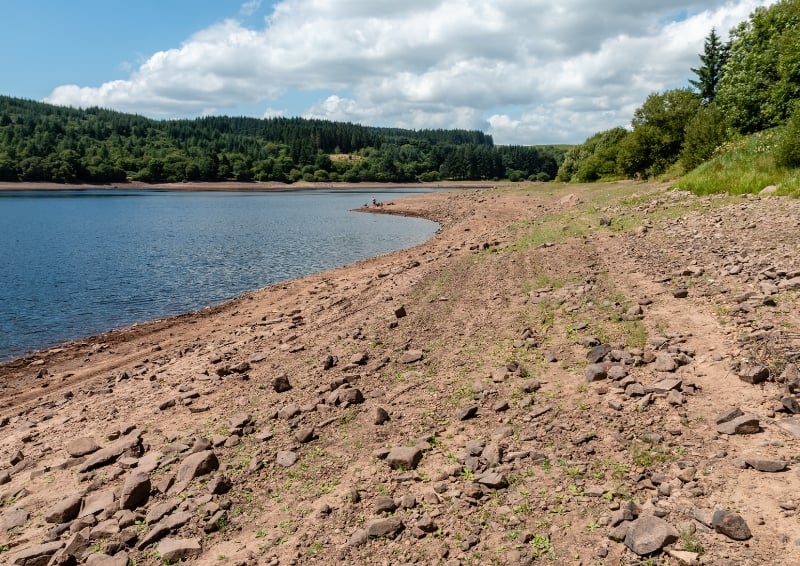
Increasing aridity is a big challenge for water resources.
Less water can be extracted from surface sources, groundwater is not recharged, and demand goes up – especially from agriculture.
The responses to water shortages should come as no surprise to civil engineers:
- reducing demand through water efficiency;
- fixing leaks (for example, by using smart sensors that can detect the sound of leaks along the network); and
- providing new supplies (including from desalination and wastewater reuse), and storage and transfer infrastructure.
It’s encouraging that investments to improve the resilience of water resources in a changing climate are now well under way.
Transport infrastructure
High temperatures cause rail tracks to buckle, leading to train speed restrictions.
Network Rail has been working to tension rail tracks so they can operate at higher temperatures since 2003.
Cooling the London Underground is a notorious problem, especially for the old lines that were not designed for air conditioning.
Energy infrastructure
Thermo-electric power plants (gas, coal, nuclear) need cooling.
This is achieved with cooling water or air-cooled systems, neither of which work as efficiently in higher temperatures.
And in hot, dry conditions, power plants on rivers can’t rely on there being enough water for cooling.
The energy transition is helping to alleviate some of those problems.
Inland thermo-electric plants are getting closed down, while new nuclear plants will be on the coast (so not subject to cooling water shortages, though seawater temperatures are impacted by extreme heat).
Wind energy supplies are not directly impacted by temperatures, and solar power gets a boost on sunny, cloud-free days.
Social infrastructure
Social infrastructure – schools, hospitals, care homes, prisons – are a particular challenge in hot weather.
There’s a vast amount of buildings (for example, England has some 24,000 schools) that are not well adapted to extreme temperatures.
And some of the occupants of social infrastructure – especially the elderly, infants and people with cardiovascular health conditions – are particularly vulnerable.

How can we adapt infrastructure for extreme heat?
All the above points to a two-pronged approach to adapting infrastructure to extreme heat.
1. Build for heat
The first is to ensure that new-build infrastructure is designed for the extreme temperatures we know will happen in the future.
There’s still some uncertainty in exactly how hot temperatures will get by the end of this century. Not least because, to some extent, that will be determined by how much carbon is emitted in the meantime.
But there are temperature projections that engineers should use.
It is reassuring that after years of pressure from the Committee on Climate Change, in 2022 the UK government mandated designing for high temperatures as Part O of the Building Regulations.
Particular attention should be paid to buildings that vulnerable people use.
2. Adapt our existing infrastructure
There needs to be continued work to adapt existing infrastructure and the built environment, ideally aligning with planned maintenance and refurbishment.
There are several steps that can be taken to enhance shading, ventilation and albedo (how reflective a surface is).
And there’s plenty of useful guidance to help asset owners and managers. For example, the Department for Education’s guidance on adapting school buildings.
Adaptation through the seasons
During the summer, air conditioning will be part of the solution.
This needn’t contribute to greenhouse gas emissions once the power grid is decarbonised (something the UK aims to do by 2030).
This is especially the case for solar energy, as its output tends to match peak electricity demand for cooling.
Yet another good reason to get more solar into our energy mix and provide the grid upgrades that can connect these supplies up with demand.
In the winter, increasing temperatures will have the benefit, on average, of reducing the need for heating, which in most homes still relies on burning expensive and carbon-emitting gas.
The engineer’s role
As with other aspects of climate change that I’ve written and spoken about during my presidential year, adapting to extreme heat is going to be a long haul.
It will require engineers to keep their knowledge up to date and exercise judgement in the face of uncertainty.
Importantly engineers need to persuade clients that action is needed now to prepare for a hotter future.
How can we build resilience to extreme heat?
To learn more about how to adapt to this hot new reality, read the ICE Civil Engineering Journal article on the topic.
Please contact the ICE member services team who will provide temporary access to the journal until the ICE's new membership management system launches.

Sustainable Development Goals:
You may also be interested in

- Type
- Awards and competitions
Recycled materials offer sustainable future for concrete in royal patron award-winning research
The annual award celebrates outstanding ideas, research and best practice.

- Type
- News
What do the 2026 party conferences mean for infrastructure?
The ICE breaks down the headline announcements from five of the major UK parties.

- Type
- Explainer
What you need to know about PAS 4010: improving productivity in infrastructure development and delivery
A new standard, which will guide the sector in improving productivity, is set to launch in 2026.