

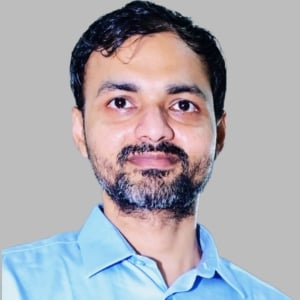
Sandeep Vaishnav
Associate civil engineer, Mott MacDonald
Expertise
Structural, Water, DesignLocation
East of EnglandMy highlights
Contributing to more than 50 wastewater treatment projects for Anglian Water in the UK
Leading civil and structural design for major phosphorus-removal and storm schemes
Delivering water, dam, hydropower and irrigation projects across India, Bhutan and Zimbabwe
I would recommend a career in civil or infrastructure engineering because…
It gives you the opportunity to create things that have a lasting impact on society.
Every project improves people's lives in some way, whether by providing clean water, protecting the environment or supporting economic growth.
What inspired you to become a civil engineer?
I have always been inspired by large infrastructure projects such as dams, water systems and hydropower schemes.
Seeing how engineering can transform communities motivated me to pursue civil engineering as a career.
We asked Sandeep…
A day in your life…
I start by reviewing surveys and site information, then work with engineers from different disciplines to develop designs for treatment plants or pumping stations.
I spend time solving engineering challenges, checking calculations, attending meetings with clients and supporting our CAD team with 3D models.
One of the most rewarding parts of my job is seeing how a design on a computer can eventually become a real asset that improves services for thousands of people.
Complete this phrase: I’m a civil engineer, but I’m also …
...a problem solver, team player and lifelong learner.
Name one civil or infrastructure engineering myth you'd like to bust.
Myth: civil engineers only design buildings.
Reality: civil engineers help create nearly all the infrastructure that society relies on, including water systems, roads, dams, flood defences and renewable energy projects.
How does your role contribute to addressing climate change?
I help develop sustainable water and wastewater infrastructure.
By reusing existing assets where possible, optimising designs and improving treatment processes, we can reduce carbon emissions and improve environmental performance.
How does your role contribute to making the industry more diverse and inclusive?
I support graduate engineers and new team members by sharing knowledge, conducting induction sessions and encouraging collaboration across teams.
Engineering benefits from different perspectives, and I enjoy helping others develop their careers.
What role does digital technology play in your job?
Digital technology is essential. I use 3D modelling, structural analysis software and digital collaboration tools to develop designs, coordinate with other disciplines and identify issues before construction starts.
What motivated you to become professionally qualified?
Professional qualification is an internationally recognised benchmark of engineering competence.
I'm pursuing this journey because I want to continuously improve my skills and demonstrate my ability to deliver engineering solutions that benefit society.
What does being professionally qualified with the ICE mean for your career?
Professional qualification demonstrates technical competence, leadership and commitment to high engineering standards.
It provides confidence to clients, colleagues and employers while supporting career progression.
How did the ICE and your employer support you to become professionally qualified?
The ICE provides guidance, resources and a professional framework for development.
My employer supports me through mentoring, training opportunities, technical reviews and exposure to challenging projects.
How has being a member helped your career?
Being an ICE member has connected me with the wider engineering community, provided access to valuable learning resources and supported my professional development journey towards Chartered Engineer status.
What’s the biggest difference you’ve noticed from studying to working in engineering?
At university, problems often have a single answer.
In industry, there are usually several possible solutions, and engineers need to balance safety, cost, sustainability, construction and operational requirements to find the best option.
Anything else? i.e. personal causes, hobbies
Outside work, I enjoy exploring innovative solutions that improve sustainability in infrastructure projects.
Sandeep's career path
I studied civil engineering at Malviya National Institute of Technology, Jaipur, graduating in 2011.
I started my career in construction before moving into consultancy, where I worked on water, hydropower and irrigation projects.
Since 2023, I've been working in the UK water sector, supporting major infrastructure programmes for water companies.
Major projects
- Slaley STW (sewage treatment works) Phosphorus Removal Scheme, Northumbrian Water
- Oakham WRC (water recycling centre) Nitrogen Removal Scheme, Anglian Water
- Copford WRC Phosphorus Removal Scheme, Anglian Water
- Irrigation scheme, Rusurunguko, Zimbabwe
- Punatsangchhu-I Hydroelectric Project, Bhutan
- Water Supply DPR (detailed project report) for 181 towns under AMRUT 2.0, India