





The need to move water has always presented a logistical challenge for civilisation.
Since ancient times, engineered solutions have allowed towns and cities to grow and farmland to thrive great distances from the nearest water source.
The Romans were renowned for their grand aqueducts, though across the world, there is evidence to show that people built and operated innovative supply systems.
In the UK, large scale water transfer systems were in place as early as the 17th century, such as the New River, which moved water from Hertfordshire to London.
Later, the Victorians constructed an extensive water transfer network to cope with the demands of an increasingly urbanised population, and much of this infrastructure remains in use today.
As the world’s population continues to grow and climate change transforms weather patterns, the organisations tasked with securing a resilient supply of water face a major challenge.
They must think more strategically and incorporate a range of solutions into their resource management plans.
One of the options involves water transfers (also known as interconnections), which enable large volumes of water to be moved from locations where there is a surplus to areas that don’t have enough.
What is a water transfer?
Broadly, a water transfer is the physical movement of water from one location to another, on any scale and by any means, to satisfy some human need.
The water resource areas may be next to each other and involve only a short transfer or straightforward re-direction of water. Or they may be separated by a greater distance with water transferred via a more extensive infrastructure system.
Different types of transfers
Bulk raw water transfer
A bulk raw water transfer is the transmission of untreated water (or minimally treated water, i.e. not fit for drinking) using canals, pipes, rivers or other means, from one region to another.
The water may come from a surface water source, a spring or groundwater, or potentially could be treated wastewater effluent (liquid waste).
It’s more practical to move raw water long distances because the quality of the water can deteriorate within a long pipe network. When it arrives closer to where it will be used, it will undergo treatment and thorough testing before it’s considered suitable for drinking.
However, care must be taken to limit the biological processes that may occur within a network carrying raw water.
Untreated water contains natural organic matter, minerals, and nutrients that fuel microbial growth. Biofilms (communities of microorganisms that stick to each other and often to surfaces) in raw water systems can result in:
- Reduced flow: thick layers narrow the interior diameter of pipes, slowing down water transport and increasing energy use for pumping.
- Pathogen shielding: the sticky outer layer of a biofilm can protect trapped pathogens like Legionella or E. coli.
- Corrosion: microbial activity can speed up the breakdown of metal as a result of the presence of acid-producing bacteria.
To avoid these problems, it’s often necessary to partially treat the water before transferring it.
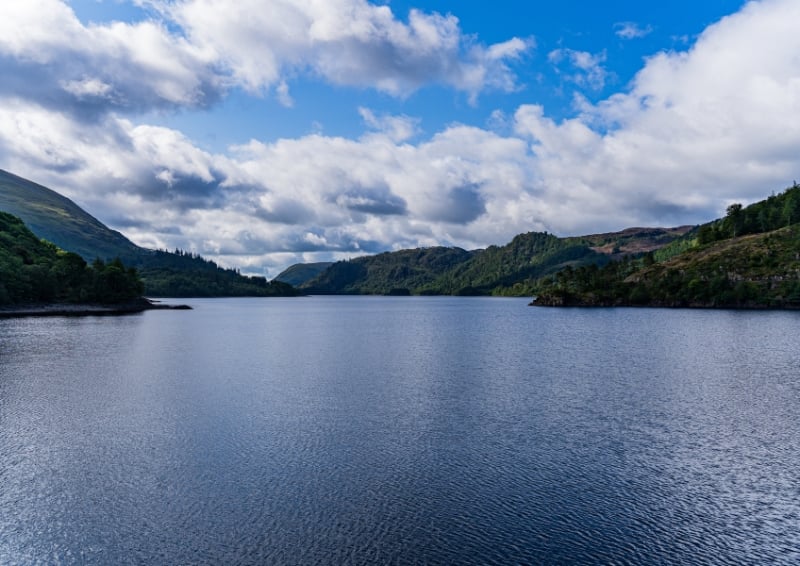
An example of a bulk raw water transfer is the Thirlmere Aqueduct, which supplies water from the Lake District to people in Cumbria, Lancashire, and Greater Manchester over a 153km route.
Bulk treated water transfer
Bulk treated water transfer is the transmission of water that has already been treated to drinking standards from one region to another. This is typically through buried pipes.
The UK has very strict rules regarding the quality of drinking water, which can deteriorate if contained within a pipe network for too long.
As a result, it’s sometimes necessary to re-treat the water before it can be supplied to homes and other customers.
Drinking water pipes also have to be thoroughly disinfected before they’re brought into service, which is a costly and time-consuming process.
Once in service, these pipelines must remain in constant use or the whole disinfection process has to be repeated.
This means that there are limits to the distance that treated water can be transferred, and once in service, these systems must operate continuously whether or not the water is needed. This can be impractical.
Intra-company transfer
An intra-company transfer is the movement of water from one location to another, entirely within one water company’s boundary.
All water companies have several sources of water within their boundary area, often of many different types (i.e. groundwater, reservoirs, rivers, etc). Each source will react to weather patterns in a different way.
The challenge for water companies is finding how best to use and distribute water from all its sources to ensure effective supply to customers throughout the year, even when things need to be taken out of service to be inspected or repaired.
Inter-company transfer
Where a water company has a shortfall in one or more of its water resource zones, which cannot be covered by interconnections from within its boundary area, it may import water from another company or provider.
Water companies are actively encouraged to develop interconnections to increase overall resilience to drought and reduce the risk of environmental damage by taking too much from their own resources.
The water regulators for England and Wales have been working with companies and other parties to ensure water supplies meet future demand.
This includes a number of water transfer projects, such as the Thames to Southern Transfer Project.
Water trade
Water trading refers to the systems and framework by which water can be bought and sold between different water companies.
Trading is an important way of making the best use of resources on a national scale and increasing overall resilience to drought.
It can also offer companies a cost-effective alternative solution to securing their water resources, in comparison with, for example, water recycling, which can be more expensive and energy intensive.
Taking water from reservoirs and rivers
Reservoirs provide storage sites for water, the release of which is regulated according to the need for water of downstream customers.
Transfers often involve raw water being released from the reservoir (via a dam), passing down the river, and then being abstracted (taken) closer to where it's needed.
Barriers to such systems can be where there are sources of pollution discharging into the river, which are difficult to treat.
Nevertheless, these systems operate across the UK with notable examples including the reservoirs in North Wales that feed water into the River Dee.
Water abstracted from the Dee downstream can provide for up to 2 million people, including customers of Severn Trent Water, Dwr Cymru Welsh Water and United Utilities.
Long-distance transfer
In some locations, an effective solution can be to transfer water from a plentiful source over a long distance (i.e. hundreds of kilometres) via structures such as canals, viaducts or pipelines.
These projects involve significant construction costs, large-scale infrastructure and high energy demands for moving water, for example, through pumps.
To justify these economic and environmental impacts, such projects must normally be the only viable solution to extreme water scarcity and/or yield several additional benefits.
An example of such a scheme is the Lesotho Highlands Water Project – Africa’s largest water transfer scheme, built at a cost of billions.
As well as providing water to South Africa, it generates income for Lesotho, has improved its transport infrastructure and offers hydropower that meets most of the country’s energy needs.
Not all water is the same
Water that has passed through rocks and soil before being stored in an underground reservoir tends to have a high mineral content (hard water).
Meanwhile, water that has fallen from the sky and simply filled a large impounding reservoir (an artificial lake, created by damming a river) tends to have a low mineral content (soft water).
Introducing soft water into a network that’s been designed for hard waters can cause many problems. For instance, it can severely affect drinking water biofilms.
Water companies employ chemists and other specialists who are tasked with maintaining water quality.
Still, this sometimes results in water transfers schemes being unviable or more limited than had been hoped.


You may also be interested in

- Type
- ICE Community blog
What's the foundation of flood resilience? Information
ICE President David Porter explains why being informed about flood risk is so important for the public and civil and infrastructure engineers.

- Type
- Awards and competitions
It’s electrifying! South Wales Metro track transformation bags top award
The electrification of the Core Valley Lines impressed the judges at the 2026 British Construction and Infrastructure Awards.

- Type
- Civil Engineer blog
The long-term consequences of a really good idea
Good decisions made at speed can lead the industry down unintended paths, writes Steven Yule, ICE country representative for the UAE.